
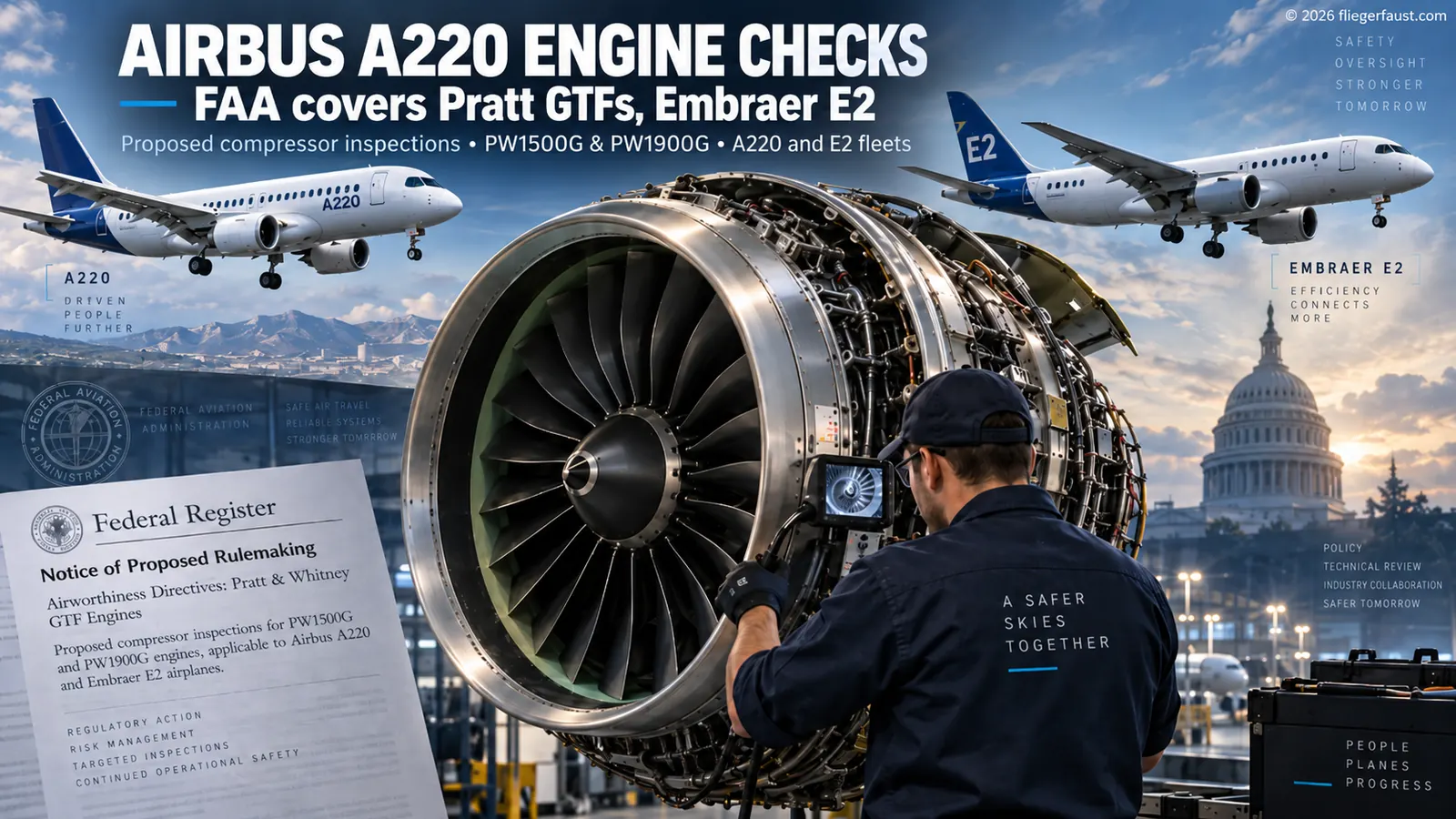
Airbus A220 engine checks: how widely could the Federal Aviation Administration’s proposed compressor inspections reach across A220 and Embraer E2 fleets?
On September 17, 2026, the Federal Aviation Administration (FAA) published a notice of proposed rulemaking covering certain Pratt & Whitney PW1500G and PW1900G engines.
The proposal follows six maintenance-shop findings involving contact between high-pressure-compressor rotors and variable stator vanes. If adopted, it would require initial and recurring borescope inspections, removal of damaged rotor parts and eventual replacement of affected bushing sets.
However, this is not yet a final airworthiness directive. It does not order an immediate fleetwide grounding, and it does not automatically apply to every A220 or E2 aircraft. Actual applicability depends on engine model, configuration and high-pressure-compressor module serial number.
Airbus A220 engine checks follow six compressor findings
Wear allowed stator vanes to contact compressor rotors
The FAA says Pratt & Whitney reported six shop findings of “clashing” involving the second- or third-stage high-pressure-compressor rotor. Wear inside the variable stator vane (VSV) bushing set allowed a vane to move forward from its intended position.
Consequently, the vane’s inner locating ring could contact the rear rim of the adjacent compressor rotor. The proposed rule addresses the first-, second- and third-stage rotor surfaces because the resulting wear could affect more than the stage where technicians first discovered contact.
The six reports were maintenance-shop findings, not six reported in-flight engine failures. Nevertheless, the FAA considers the underlying condition serious because continued contact could weaken rotating compressor components.
“The unsafe condition, if not addressed, could result in uncontained part release…” — Federal Aviation Administration, Federal Register.
An uncontained failure occurs when high-energy engine debris escapes the engine casing. The FAA also identifies possible engine damage, aircraft damage and loss of aircraft control among the consequences it seeks to prevent.
A prior uncontained PW1500G failure offers historical context
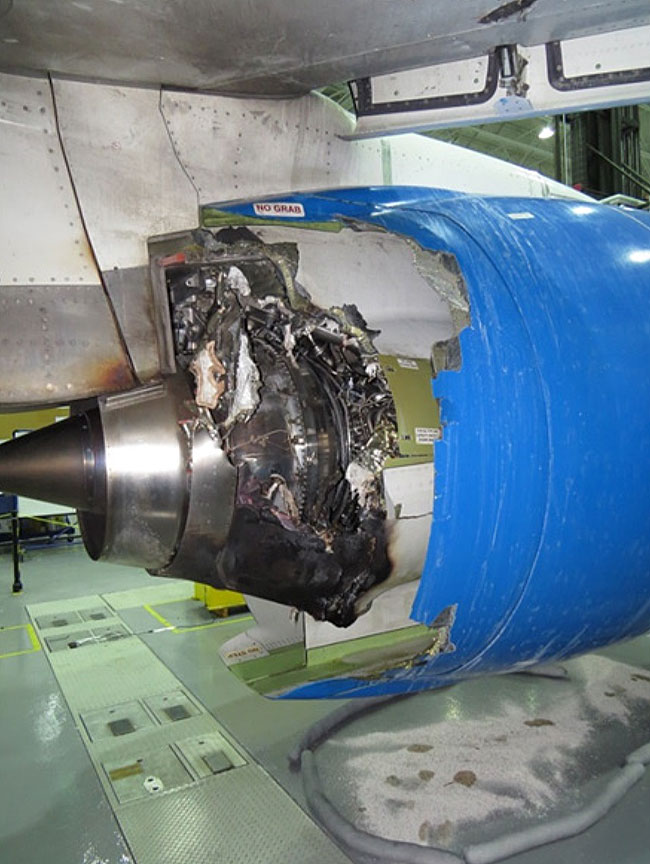
The risk of an uncontained failure is not abstract for the A220 programme, although the 2014 event involved a different mechanism from the compressor-bushing condition behind the current FAA proposal. On May 29, 2014, the left Pratt & Whitney Canada PW1524G on Bombardier CS100 Flight Test Vehicle 1 (FTV1), now known as the A220-100, suffered an uncontained low-pressure-turbine rotor failure during ground runs at Montréal–Mirabel while Pratt & Whitney engineers were troubleshooting excessive oil consumption. The Transportation Safety Board of Canada investigation found that hot shutdowns caused heat soaking beyond the design limits of a No. 4 bearing oil-feed tube Teflon C-seal. Its failure allowed oil to enter the turbine cooling-air stream, auto-ignite and overheat the rotor until it failed, causing major damage to the engine, nacelle and wing. All six occupants evacuated without injury, and Bombardier grounded the CSeries test fleet while Pratt & Whitney introduced revised cool-down procedures, an enhanced seal and production changes intended to prevent recurrence.
Excerpt from my forthcoming book on the complete history of the Bombardier CSeries:
This wasn’t just any engine. The engines on FTV1 were the original duo, the very first made by Pratt & Whitney for the CSeries. Notably, one of these engines, the premier one delivered by Pratt & Whitney, exhibited a unique trait—it consumed oil at an unusually high rate, differing from subsequent engines.
It’s worth underscoring that, on the day before the incident, an oil pump on this particular engine had been…
In turbine machinery, a small bushing can write a remarkably large maintenance invoice.
This remains a proposal, not an active mandate
The FAA published the notice under docket number FAA-2026-8816 and project identifier AD-2026-00605-E. Public comments must reach the agency by October 19, 2026.
Therefore, the proposal itself does not yet create a new FAA compliance obligation. The agency may revise the requirements after reviewing comments, or it may proceed toward a final airworthiness directive.
The FAA also calls the proposal an interim action. Pratt & Whitney is developing additional mitigations, and the regulator may consider further rulemaking after those measures become available.
That distinction matters. A proposed rule signals a regulator’s intended response, but its inspection thresholds and final legal wording can still change.
Airbus A220 engine checks also reach Embraer E2 jets
Four aircraft models use the covered engine families
Airbus A220 engine checks form only part of the FAA proposal. The rule would cover selected engines installed on four commercial aircraft models: the Airbus A220-100, Airbus A220-300, Embraer E190-E2 and Embraer E195-E2.
The Pratt & Whitney PW1500G exclusively powers the A220-100 and A220-300. The FAA proposal lists the PW1519G, PW1521G, PW1521GA, PW1521G-3, PW1524G, PW1524G-3, PW1525G and PW1525G-3 variants.
Meanwhile, the PW1900G powers the Embraer E190-E2 and E195-E2. The proposal lists the PW1919G, PW1919G-RC, PW1921G, PW1921G-RC, PW1922G, PW1923G and PW1923G-A variants.
The notice does not list the PW1100G-JM used by the Airbus A320neo family. Therefore, this specific proposal should not be described as applying to every Pratt & Whitney geared turbofan installation.
Not every A220 or E2 engine is automatically affected
Aircraft type alone does not determine applicability. The proposed directive applies only when a listed engine contains a high-pressure-compressor module whose serial number appears in one of two Pratt & Whitney Alert Service Bulletins dated July 13, 2026.
Those bulletins identify the affected module serial numbers and describe inspection procedures for the PW1500G and PW1900G families. Engines that have already incorporated specified Pratt & Whitney service-bulletin modifications would be excluded.
Consequently, operators must review each engine’s configuration and module records. A fleet may contain affected and unaffected engines even when every aircraft uses the same engine family.
The FAA estimates that the proposal would affect 215 engines installed on aircraft of United States registry. That figure refers to engines, not aircraft, and it does not represent the complete worldwide fleet.
The rule follows module serial numbers, not airline liveries.
GTF inspection rule would require recurring checks
Initial inspections would begin around 8,000 flight hours
If adopted as proposed, operators would inspect the rear rim surfaces of the first-, second- and third-stage high-pressure-compressor rotors. Technicians would look for circumferential wear, scratching or other evidence of contact with the VSV inner locating ring.
The first borescope inspection would be required before an affected engine accumulates 8,000 flight hours, or within 1,000 flight hours after the directive’s effective date, whichever occurs later.
Thereafter, the operator would repeat the inspections at intervals not exceeding 1,000 flight hours. The schedule creates a continuing monitoring requirement until the affected bushing set receives the terminating modification.
If an inspection finds qualifying damage, the proposal requires removal of each damaged first-, second- or third-stage rotor component before further flight. The operator would then install a rotor eligible for service.
Separately, the affected VSV bushing set would need replacement during the next maintenance event involving separation of the high-pressure-compressor front-case split flange. Installing the approved replacement bushings would terminate the recurring borescope requirement.
The FAA’s approach therefore combines surveillance with a permanent hardware action. It does not demand immediate removal of every affected engine, but it does not permit identified rotor damage to remain in service.
Direct compliance costs could exceed US$4 million
The FAA estimates that each borescope inspection would require three work-hours. At the agency’s assumed labour rate, the direct cost would be US$255 per engine, or approximately US$54,825 across the estimated United States population.
Replacing the VSV bushing set would cost an estimated US$20,385 per engine, including US$20,300 in parts. Across 215 engines, the FAA estimates direct bushing-replacement costs of approximately US$4.38 million.
Those figures do not include every possible consequence. If inspections reveal rotor damage, the FAA estimates replacement costs ranging from US$258,950 to US$316,050 per affected rotor stage. The agency cannot yet estimate how many engines may need those repairs.
Moreover, the published cost table measures direct labour and parts. It does not quantify schedule disruption, spare-engine demand or the operational effect of removing a damaged engine from service.
A borescope is cheaper than a compressor rotor, but neither is free when the maintenance schedule is already crowded.
GTF inspection rule adds another focused maintenance task
The proposal should not be confused with a blanket GTF verdict
Timing matters. A220 operators have already managed durability issues, limited shop capacity and extended engine-removal cycles. Our Fliegerfaust analysis of A220 engine availability examined that wider maintenance environment.
Additionally, our Fliegerfaust coverage of Air Austral’s A220 fleet exit documented how engine availability can affect schedules, costs and long-term fleet decisions.
The latest proposal does not prove that another large-scale grounding cycle will follow. It uses serial-number limits, recurring inspections and a terminating bushing replacement rather than ordering wholesale engine removal.
However, an affected engine that fails inspection could still require expensive rotor work and additional shop capacity. The operational effect will therefore depend less on the headline aircraft type than on how many modules fall inside the affected serial-number population.
Conclusion: GTF inspection rule needs careful perspective
The FAA has identified a credible compressor risk and proposed a measured response. The plan relies first on borescope inspections, then requires hardware replacement during an appropriate compressor maintenance event.
That approach appears more proportionate than a blanket fleet grounding. Even so, the potential consequences of an adverse inspection are substantial because damaged rotor stages must leave service before further flight.
My critical view is that operators should resist both extremes. This proposal is not evidence that every A220 and E2 engine faces imminent failure. Equally, six compressor-contact findings should not be dismissed merely because technicians discovered them in maintenance shops rather than during flight.
What do you think?
The decisive questions now concern serial-number exposure, inspection findings and maintenance capacity. Will the proposed GTF inspection rule remain a contained preventive action, or will the first inspection cycle reveal a broader compressor burden?
Leave your comments below and on our Fliegerfaust Facebook page.
Sources
- Federal Aviation Administration / Federal Register — Airworthiness Directives; Pratt & Whitney Engines (September 17, 2026).
- Pratt & Whitney — Pratt & Whitney’s Geared Turbofan Engine for Airbus A220 Achieves FAA ETOPS Certification (July 16, 2018).
- Pratt & Whitney — Pratt & Whitney Adds the PW1900G Engine to OGMA’s GTF MRO Capability (November 19, 2021).
- Transportation Safety Board of Canada — Air Transportation Safety Investigation A14Q0068: Uncontained Turbine Rotor Failure, Bombardier CS100 C-FBCS (report published July 5, 2016; occurrence May 29, 2014).
For full details, please refer to our Disclaimer page.