

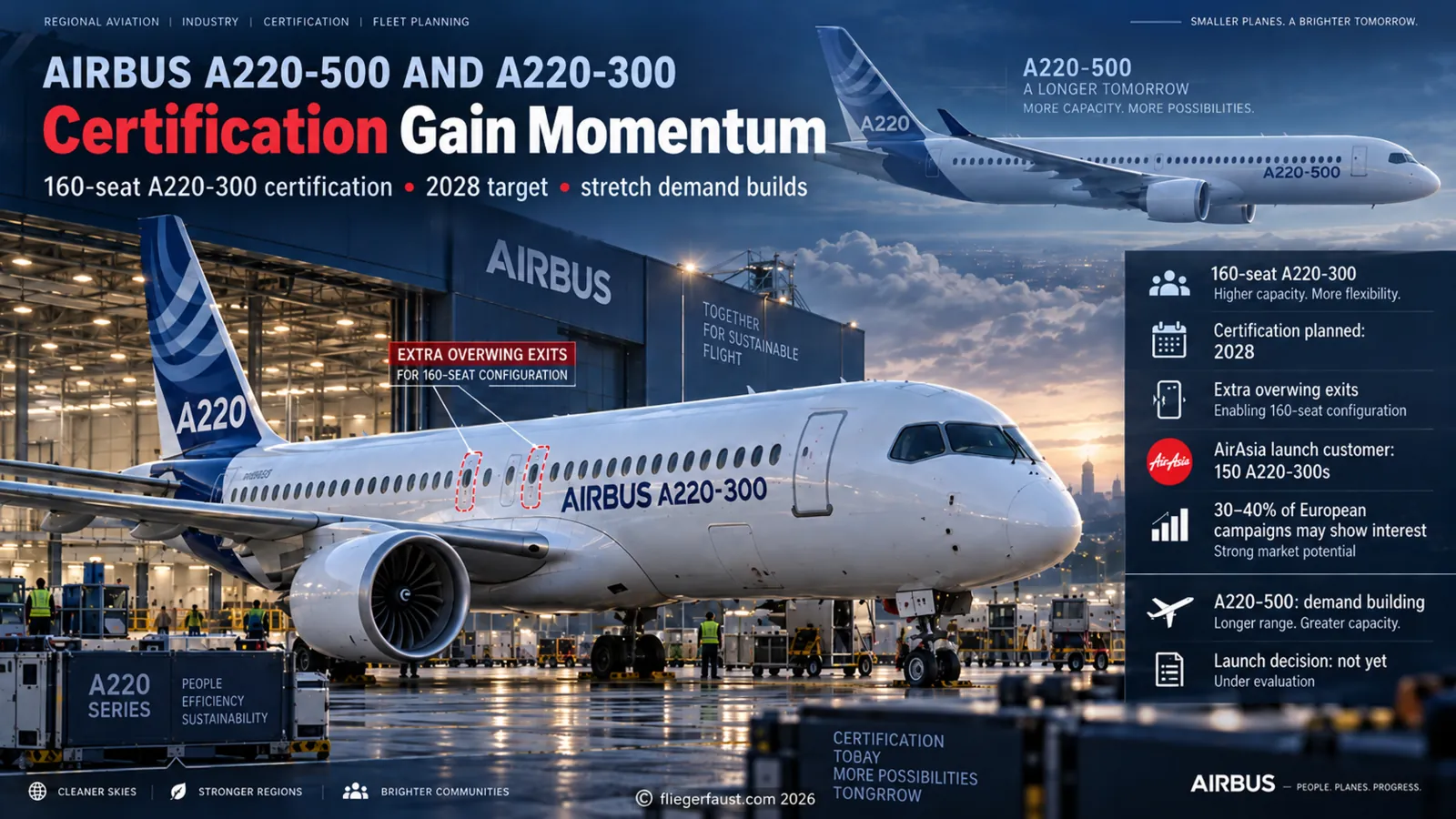
Airbus A220-500: is the 160-seat A220-300 certification programme becoming the commercial evidence Airbus needs before deciding whether to launch the long-discussed A220-500 stretch?
That question sharpened on October 7, 2026. In a new Aviation Week interview with Airbus, Europe region president and head of commercial Europe Johan Pelissier offered a numerical indication of demand. He estimated that roughly 30–40% of the European sales campaigns he follows could be interested in a 160-seat A220-300.
Aviation Week also reports that Transport Canada certification is planned for 2028. The same interview carries another important signal: Airbus sees demand for a larger A220, while Pelissier says the immediate priority remains ramping production of the A220-100 and A220-300.
Airbus still has not launched the A220-500. However, the higher-density A220-300 now gives the manufacturer another way to measure how strongly airlines value greater capacity within the A220 family.
Airbus A220-500 meets 160-seat A220-300 certification
The 160-seat A220-300 is no longer simply an engineering proposal. Our Fliegerfaust coverage of the A220 160-seat certification programme examined the structural modification required to support the higher passenger count. Airbus plans an additional overwing emergency exit on each side of the aircraft.
AirAsia then converted the concept into a major commercial programme. Its order for 150 A220-300s made it the launch customer for the 160-seat configuration. The deal also pushed the A220 beyond 1,000 firm orders, as detailed in our Fliegerfaust coverage of the AirAsia A220 order.
That commitment matters for more than backlog. It gives Airbus a large operator prepared to build part of its future network around the densest A220-300 configuration yet planned.
The reported European interest broadens that signal. If a meaningful share of Airbus campaigns wants 160 seats, the requirement is no longer confined to one Asian low-cost carrier.
Airbus A220-500 case grows with A220-300 certification
The certification programme gives Airbus a relatively direct way to improve seat economics without first launching another fuselage length. Ten additional seats can materially change revenue potential on dense routes, particularly where maximum range is not required.
That still does not make the 160-seat A220-300 an A220-500 substitute. A higher-density cabin extracts more capacity from the existing aircraft. A stretch would seek greater capacity through a larger airframe.
That larger aircraft would reopen questions around weight, field performance, range, wing capability and thrust. Our Fliegerfaust technical analysis of the A220-500 examined those trade-offs in detail.
The engineering problem has never been whether Airbus can lengthen the fuselage. The harder question is how much of the A220-300’s performance Airbus can preserve while carrying more passengers.
Commercially, the 160-seat programme may become a useful test. If airlines repeatedly ask Airbus for greater A220 capacity, the data begin to say something about demand beyond the -300 itself.
Airbus can therefore observe how strongly airlines value each incremental step toward higher A220 capacity before committing to a full stretch.
Airbus A220-500 language grows more confident
Airbus still has not made the decision that matters most: a formal A220-500 launch.
That caution is consistent with our earlier reporting. In January, our Fliegerfaust A220-500 update from Dublin examined renewed industry discussion around a stretch, engine durability and production.
By June, our Fliegerfaust analysis of A220-500 launch timing found that expectations for an imminent programme decision had weakened. Airbus appeared focused on range, production and the economics of the existing family.
The October language is therefore notable.
Pelissier told Aviation Week that Airbus sees market demand for the stretch. After stressing the need to focus first on the existing A220 ramp, he added:
“But it’s more a question of when.” — Johan Pelissier, Airbus Europe region president and head of commercial Europe, Aviation Week
Five words do not constitute an aircraft launch. They do represent stronger language than simply confirming that Airbus continues to study the aircraft.
Airbus now has several layers of evidence to consider. Existing operators want more capacity. AirAsia has backed the 160-seat A220-300 at scale. European campaigns are showing interest in the denser configuration. Airlines also continue to ask about a larger family member (i.e. A220-500).
Airline demand for the A220-500 has been building for years
Airline pressure for a larger A220 is not a new development. Airbus executives have acknowledged that customer pull for a stretch has been building for years, while several operators have publicly discussed how a larger member of the family could fit their fleets.
Air France-KLM has been associated with the concept since at least 2019–2020. More recently, Air Canada has publicly described the proposed A220-500 as an aircraft it would examine seriously if Airbus brings it to market. In July, Skies reported that Airbus had accelerated its stretch studies, with Airbus Canada CEO Guillaume Chevasson saying customers were actively pushing for the aircraft.
Airbus Chief Executive Guillaume Faury reinforced that message in June, saying the manufacturer continued to hear interest from numerous customers even while questions over the final design and launch timing remained unresolved. Air Data News’ coverage of those comments also highlighted Air France-KLM’s continuing pressure for the stretch.
The latest Aviation Week reporting makes that customer picture more explicit, identifying Air France-KLM, Delta Air Lines, Air Canada and Lufthansa among airlines that would like Airbus to develop the A220-500. That does not represent the beginning of demand for the aircraft. It adds four major airline groups to an increasingly well-documented pattern of customer pressure that Airbus has been acknowledging for years.
Our Fliegerfaust coverage of the A220-500 launch debate has followed that tension between airline demand and Airbus’s reluctance to launch before the existing programme reaches the production and economic maturity required to support another derivative.
Airbus A220-500 still depends on production scale
Demand alone cannot launch the next A220. Airbus also needs an industrial system capable of supporting it. The company is targeting production of 13 A220s per month in 2028. In August, Airbus began a 6,221-square-metre expansion of its Belfast wing facility. Completion is planned for the first half of 2028.
The project adds a third autoclave, specialised tooling and other production infrastructure. Airbus says Belfast is the exclusive global manufacturer of A220 wings.
Our Fliegerfaust coverage of the Airbus–Spirit AeroSystems deal examined why control of that industrial base matters to the A220’s future.
Meanwhile, our Fliegerfaust analysis of the A220 ramp-up, 160-seat doors and 2025 delivery record tracked how cabin development and production capacity were beginning to converge.
Our later Fliegerfaust A220 ramp and engine outlook followed the same constraint from another direction. Orders only become useful when suppliers, engines, wings and final assembly convert them into predictable deliveries.
That is particularly important for the Airbus A220-500. A new derivative would add certification work and industrial complexity to a programme still being pushed toward higher output.
The timing is difficult to ignore. Airbus is targeting both 160-seat certification and a 13-aircraft monthly production rate in 2028. They are separate objectives, but both depend on a stronger A220 industrial system.
airBaltic gives Airbus near-term delivery flexibility
The Aviation Week report also adds an important backlog development. Pelissier said airBaltic’s remaining 40-aircraft A220 order had already been restructured before the carrier entered Chapter 11.
Near-term delivery slots were reassigned to other customers, while airBaltic’s aircraft moved toward the back of the backlog.
That adds Airbus context to a restructuring Fliegerfaust has been following closely. Our Fliegerfaust coverage of airBaltic’s Chapter 11 financing examined the €350-million restructuring facility and the carrier’s financial reset.
Our earlier Fliegerfaust analysis of airBaltic’s revised A220 fleet strategy documented the reduction in its near-term fleet ambitions. The new Airbus comments now show how that decision also affects the manufacturer’s delivery queue.
For Airbus, released positions can matter if A220-300 demand is strengthening. Delivery slots have commercial value. Airlines can admire an aircraft yet buy something else when the required delivery date is unavailable.
The airBaltic change does not create additional factory capacity. It does give Airbus more flexibility over where some near-term aircraft can go.
What 160 seats tell us about the Airbus A220-500
The important development is not simply that Airbus found room for ten more passengers.
The 160-seat configuration gives Airbus a lower-risk way to test the upper end of A220-300 demand. It can do so before committing to the much larger decision represented by an Airbus A220-500.
AirAsia has already supplied a major commercial endorsement. The reported European campaign interest suggests that demand could extend beyond one customer model.
Meanwhile, Airbus is investing in Belfast, targeting higher output and acknowledging market demand for the stretch. None of those facts guarantees an A220-500 launch. Together, they make the business case easier to measure.
There is also a strategic boundary Airbus must protect. A successful stretch would move the A220 closer to the A320neo family.
Airbus therefore has to answer two questions. Would airlines buy the larger aircraft? And would it expand Airbus’s addressable market rather than simply move customers between Airbus products?
Readers looking for Pelissier’s broader comments on airline campaigns, engines and the programme should read the full Aviation Week report. It contains additional detail beyond the certification and A220-500 developments examined here.
Conclusion: certification is real, the A220-500 decision is not
The 160-seat A220-300 and the Airbus A220-500 now sit on different sides of the same strategic question.
One is an active certification programme with a launch customer, a defined structural modification and a 2028 target. The other remains an unlaunched stretch whose commercial logic continues to strengthen.
Airbus does not need to force the two decisions together. The higher-density -300 can improve the existing product while Airbus raises output and watches how airlines respond.
That response can become part of the evidence supporting—or weakening—the case for the stretch.
The strongest signal from October is therefore not that the Airbus A220-500 is imminent. It is that Airbus is accumulating more of the conditions that could eventually justify it.
Will the 160-seat A220-300 be Airbus’s final answer for higher A220 capacity—or the commercial evidence that finally clears the way for the A220-500?
Leave your comments below and on our Fliegerfaust Facebook page.
For full details, please refer to our Disclaimer page.