
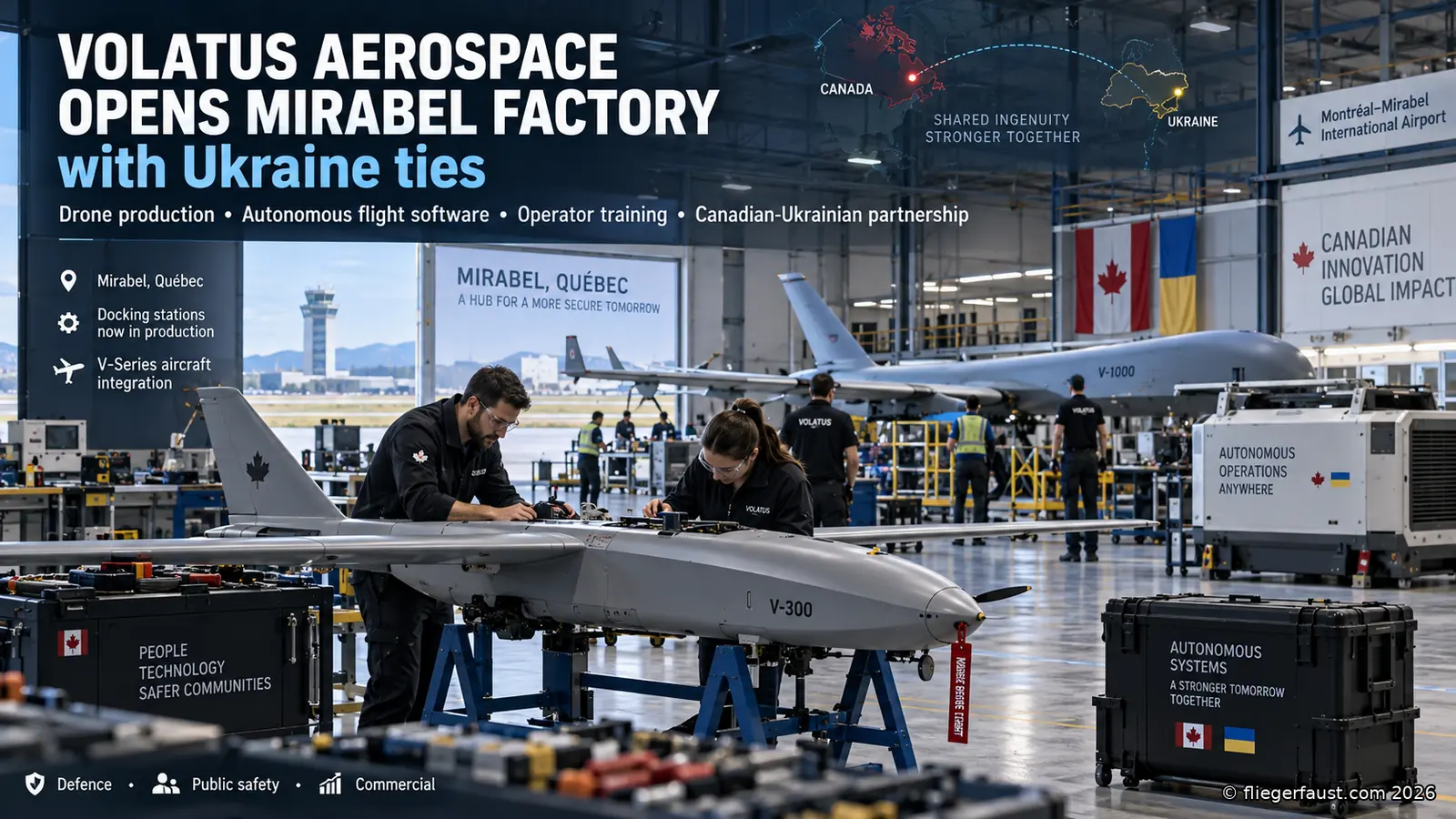
Volatus Aerospace has opened its Mirabel drone factory—but what is taking shape inside, and how does Ukraine fit? The answer runs through aircraft engineering, autonomous flight software, operator training and a partnership connecting Ukrainian developers with Canadian manufacturing.
On September 29, 2026, the company formally opened its 53,000-square-foot facility at Montréal–Mirabel International Airport (YMX), Québec Canada. Its GlobeNewswire opening announcement confirms docking-station production and V-Series aircraft integration and production. Defence, public-safety and commercial customers share the plant’s target market.
In fact, production preceded the ceremony. Volatus’s June 23 announcement reported docking stations already reaching commercial customers. The September opening therefore marks a manufacturing operation advancing beyond its first products. It follows the plans outlined in our Fliegerfaust coverage of the original October 2025 hub announcement.
Volatus Aerospace builds an aircraft business at Mirabel
The facility’s importance starts with the engineering behind its aircraft. On October 27, 2025, Volatus Aerospace announced a C$2-million agreement to acquire aircraft technology from Caliburn Holdings, a British aerospace engineering firm.
Crucially, the transaction covered complete designs, flight-test data and engineering documentation. It also provided for the original engineering team to join Volatus and relocate to Mirabel. The plan placed production, integration and flight testing together.
That combination gives the industrial project more substance than an assembly contract alone. Engineers who understand an aircraft’s design can investigate faults and manage modifications alongside production staff. In turn, the technical records provide the reference against which they can assess those changes.
Our Fliegerfaust March 2026 project update traced the transition from aircraft-technology acquisition to manufacturing preparation. The September opening brings that industrial development into operation.
Mirabel drone factory: three aircraft, different missions
The V-Series is a family of fixed-wing aircraft, rather than a single model. Volatus’s published specifications describe progressively larger platforms for industrial monitoring and extended surveillance.
For example, the Volatus V100 Viscount specification lists a 6.5-metre wingspan and a maximum takeoff weight of 100 kilograms. Its published maximum endurance reaches 18 hours. Volatus positions the aircraft for commercial surveillance and infrastructure inspection.
By comparison, Volatus Aerospace’s V200 Vantage offers a published endurance of up to 35 hours and a 30-kilogram payload. That combination supports missions requiring both extended flight time and substantial sensor equipment. In particular, payload capacity determines how much mission equipment an aircraft can carry alongside its own flight systems.
At the larger end, Volatus’s V300 Vigil has a 10-metre wingspan and a maximum takeoff weight of 260 kilograms. The company advertises endurance of up to 168 hours, or seven days.
V-Series specifications and flight evidence
Volatus’s published V300 specifications do not align. The Volatus Aerospace defence-page comparison table lists an 8-kilogram maximum payload and an 800-kilometre range at maximum payload. However, the Volatus Aerospace V300 product page targets a 60-kilogram payload over 18,000 kilometres. Both pages advertise an overall range of 18,000 kilometres. The unexplained discrepancy concerns the payload and the range achievable while carrying it.
Separately, our research found no public, model-specific record documenting a completed flight by the V100 Viscount, V200 Vantage or V300 Vigil. That search covered publicly available material through October 2, 2026.
Volatus’s October 27, 2025 acquisition announcement, published by GlobeNewswire says the acquired technology included validated flight-test data. However, that release does not identify the tested models, flight dates or achieved performance. The advertised endurance figures therefore remain company claims, not flight results verified for this article.
Docking stations make repeated operations practical
Meanwhile, the plant’s first announced product category addresses what happens between flights. A docking station shelters and services a drone while connecting it to remote operators.
Volatus Drones’ AeriePort product description illustrates the company’s approach. Specifically, the station combines automated charging and battery replacement with climate control, weather monitoring and remote mission planning. It also streams aircraft data and camera imagery to a control centre.
For an industrial customer, the operational attraction is repeatability. A drone can return to a prepared base rather than require an entirely new field setup for each mission. Aircraft, ground equipment, communications and maintenance therefore become parts of one operating system.
Engineers, flight software and training move closer together
Volatus Aerospace is also moving technical leadership towards the production floor. Canadian Defence Review reported on September 30 that staff transfers to Mirabel included chief technology officer Krish Srinivasan. The company is coordinating the plant with its defence activities and commercial remote-operations centre in Vaughan, Ontario.
Srinivasan’s remit extends beyond individual airframes. His February 23 appointment announcement from Volatus assigned him leadership of a unified engineering organization spanning Canada, the United States and the United Kingdom. Its work includes autonomy, mission systems, docking infrastructure and counter-drone technology.
Bringing those disciplines together addresses a practical manufacturing problem: a change to one subsystem can affect several others. The team must consider the aircraft, its software and its ground equipment as a connected product.
Additionally, the Mirabel airport places Volatus within a wider engineering and training network. An April 14 announcement from airport operator Aéroports de Montréal identifies National Research Council (NRC) of Canada and Airbus Protospace initiatives at YMX. The council’s drone-innovation work targets technology validation, while Protospace supports experimentation and training.
Those neighbouring activities complement the company’s own production and technical teams. Together, they explain the location’s attraction: Mirabel offers an aerospace development environment as well as manufacturing space.
Volatus drone production gets a common software foundation
The company’s V-Cortex flight controller makes that approach tangible. According to Volatus Aerospace’s May 27 V-Cortex launch release, the Canadian-developed hardware measures approximately 3.5 centimetres by 3.5 centimetres. The controller weighs less than 15 grams.
Its associated software handles autonomy and mission-system integration. In particular, the modular design supports adding sensors and other equipment without redesigning the entire aircraft. Volatus intends the technology to serve multiple platforms, including its own aircraft and partner systems.
Subsequently, Volatus reported an initial V-Cortex flight-test milestone on September 22. The system navigated using onboard sensors without Global Positioning System (GPS) signals. The company plans additional testing as it advances towards operational deployment. Its reported test configuration used standard onboard sensors rather than an added external navigation package.
For Mirabel, the manufacturing significance is a reusable control-and-software foundation. Instead of treating every airframe as an unrelated engineering project, the company can develop common functions across its product range. GPS-independent navigation also addresses a requirement directly relevant to disrupted satellite positioning.
Training becomes part of the delivered product
Additionally, Danielle Gagné, head of global training strategy and business development, has moved from Portland, Maine, to Montréal. Canadian Defence Review describes plans for Mirabel to become a training and educational-content centre. The plan includes bilingual technical and operational documentation.
Gagné’s assessment of an aircraft without a trained operator is pointed: “But without training it’s just a paper weight.” — Danielle Gagné, Head of Global Training Strategy and Business Development, Canadian Defence Review.
That work already has a customer connection. A December 15, 2025 Volatus Aerospace defence-contract announcement described a two-year training-system program worth up to C$9 million. The allied customer’s package includes flight and sensor-operation training interfaces, documentation and on-site instructor familiarization.
Mirabel’s role extends beyond shipping equipment. Training gives operators the procedures and practical knowledge needed to use the system consistently. Similarly, documentation provides a common reference when customers require technical support.
Volatus Aerospace connects Mirabel with Ukrainian technology
The company’s Ukrainian relationship predates this factory. Indeed, its November 7, 2022 results announcement, published by Newsfile, recorded continuing deliveries of intelligence, surveillance and reconnaissance (ISR) drones to Ukraine.
However, the newer relationship adds a specific industrial role for Mirabel. On May 28, 2026, Volatus Aerospace and UCan Brave Tech Centre announced a memorandum of understanding covering Canadian–Ukrainian defence-technology cooperation.
UCan, a Canadian nonprofit, connects Ukrainian innovators with Canadian industry and other stakeholders. Volatus contributes manufacturing, systems integration, deployment and continuing support. The agreement expressly identifies its Mirabel capabilities as resources for developing and scaling validated Ukrainian technologies.
Specifically, the partners identify autonomous systems, counter-drone technology, ISR, resilient communications and autonomy software as areas of cooperation. This places the factory within a development-and-commercialization relationship, with a role broader than supplying completed aircraft.
Meanwhile, Ukrainian operational experience is informing the company’s engineering priorities. Canadian Defence Review describes Volatus monitoring changes in electronic warfare, navigation, cameras and propulsion. “We need to react fast as strategies shift.” — Glen Lynch, Chief Executive Officer, Canadian Defence Review.
Mirabel manufacturing hub: turning experience into repeatable production
In practice, the opportunity is to shorten the distance between operational feedback and an improved product. A communications problem, a navigation requirement or a different sensor can trigger changes across hardware, software and training.
Mirabel brings those functions into the same industrial program. Its engineering records, production capability and training team offer the means to develop a change, document it and help customers use it. That is the significance of the Ukrainian technology connection.
Separately, Canada’s September 10 announcement from the Prime Minister’s Office established a wider bilateral production initiative. It named General Dynamics Mission Systems–Canada and Ukraine’s Green Tech Harvest as industrial partners. The announcement also introduced Canadian drone procurements worth up to C$50 million across several suppliers.
For the wider funding and industrial-policy context, see our Fliegerfaust analysis of the Canada–Ukraine drone deal. Volatus’s own disclosed initial military order serves the Canadian Armed Forces (CAF), while the UCan agreement supplies its direct Ukrainian technology-development channel.
Volatus Aerospace pursues military and wildfire customers
The immediate defence workload starts with 100 tactical ISR drone systems. Volatus’s September 10 Canadian contract announcement sets out a five-year arrangement, with initial deliveries scheduled for October–December 2026.
Canada holds options for another 4,900 systems. The procurement framework sets a C$5,000 maximum per system and a C$25-million overall ceiling. The starting quantity for the CAF is 100 systems. Further purchases depend on Canada exercising those options.
Importantly, the CAF package includes aircraft, sensors, ground-control stations, data links, training, spares and continuing support. That scope connects the manufacturing floor with the software, training and service functions Volatus is building around it.
One material detail needs a clear answer. The Prime Minister’s Office backgrounder names the Huntsman X6 and says manufacture takes place in the United Kingdom. Its companion news release says the Montréal area. Neither explains the manufacturing workshare, leaving readers without a consistent account of where this particular aircraft will take shape.
Wildfire surveillance adds a civilian manufacturing pathway
Meanwhile, an August 5 agreement between Volatus and Kraus Hamdani Aerospace expands Mirabel’s prospective aircraft work beyond military customers. The partnership covers the K1000ULE, a fully electric, long-endurance autonomous aircraft, alongside airborne communications technology.
Notably, Kraus Hamdani reports a continuous flight exceeding 75 hours with mission equipment aboard.
The proposed Canadian applications begin with wildfire response. Cameras and thermal sensors would track fire boundaries and hotspots. Communications equipment would relay information and connect responders across large operating areas. The airborne network also bridges older and newer radio systems, according to the partnership announcement. The same persistent-surveillance and communications capabilities could support border and Arctic monitoring. Notably, Kraus Hamdani Aerospace identifies U.S. Customs and Border Protection among existing customers for its technology.
Additionally, the agreement establishes a progression through Canadian systems integration, operator and maintainer training, and continuing support. Licensed manufacturing at Mirabel forms part of that development plan. Emergency management, Arctic operations and defence provide further intended markets.
This creates a practical connection between the factory’s civilian and military ambitions. Extended surveillance, dependable communications and supported operations matter in both markets. The same engineering organization can address different customers without treating every mission as a completely separate business.
Financing the Mirabel drone factory—and filling it with work
The funding trail began before production started. Volatus’s C$26.39-million financing, closed November 26, 2025, expressly included Mirabel development among its intended uses. Subsequently, another financing raised C$34.5 million on June 5, 2026.
The Volatus Aerospace financial results released August 13 show C$59.2 million in cash at June 30. Second-quarter revenue reached C$8.42 million, compared with C$10.59 million a year earlier. The company recorded a C$14.09-million first-half net loss.
Supply-chain performance remains a concrete operating issue. Specifically, Volatus attributed a delay in approximately C$2.6 million of defence revenue to component supply. Equipment availability therefore matters as much as production space when converting contracts into completed deliveries.
During the August 14 earnings call, Lynch estimated potential annual revenue capacity at approximately C$250 million, depending on product mix. Benzinga’s transcript of the Volatus call also records docking units shipped to Western Canada for standby wildfire deployment.
Chief financial officer Abhinav Singhvi identified batteries as the source of the delayed defence deliveries. The immediate task is matching that installed capacity with available components and accepted customer deliveries.
Conclusion: The factory’s advantage must reach the customer
Volatus Aerospace has assembled more than floor space at Mirabel. Aircraft engineering, a common autonomy platform, docking equipment and operator training give this project an identifiable industrial purpose. Its Ukrainian partnership adds a route for bringing operationally tested ideas into that organization.
Ultimately, the strongest commercial argument is the connection between those functions. Customers need an aircraft that performs, software they can support and technicians who can resolve problems. Bringing those capabilities together is more valuable than adding another model to a catalogue.
Our assessment is that the factory’s real test lies in execution: delivery schedules, reliable field performance and the speed of useful upgrades.
Volatus has outlined the product range and established the infrastructure. Can Mirabel now turn that combination into repeat business and a durable Canadian aerospace operation?
Leave your comments below and on our Fliegerfaust Facebook page.
For full details, please refer to our Disclaimer page.