
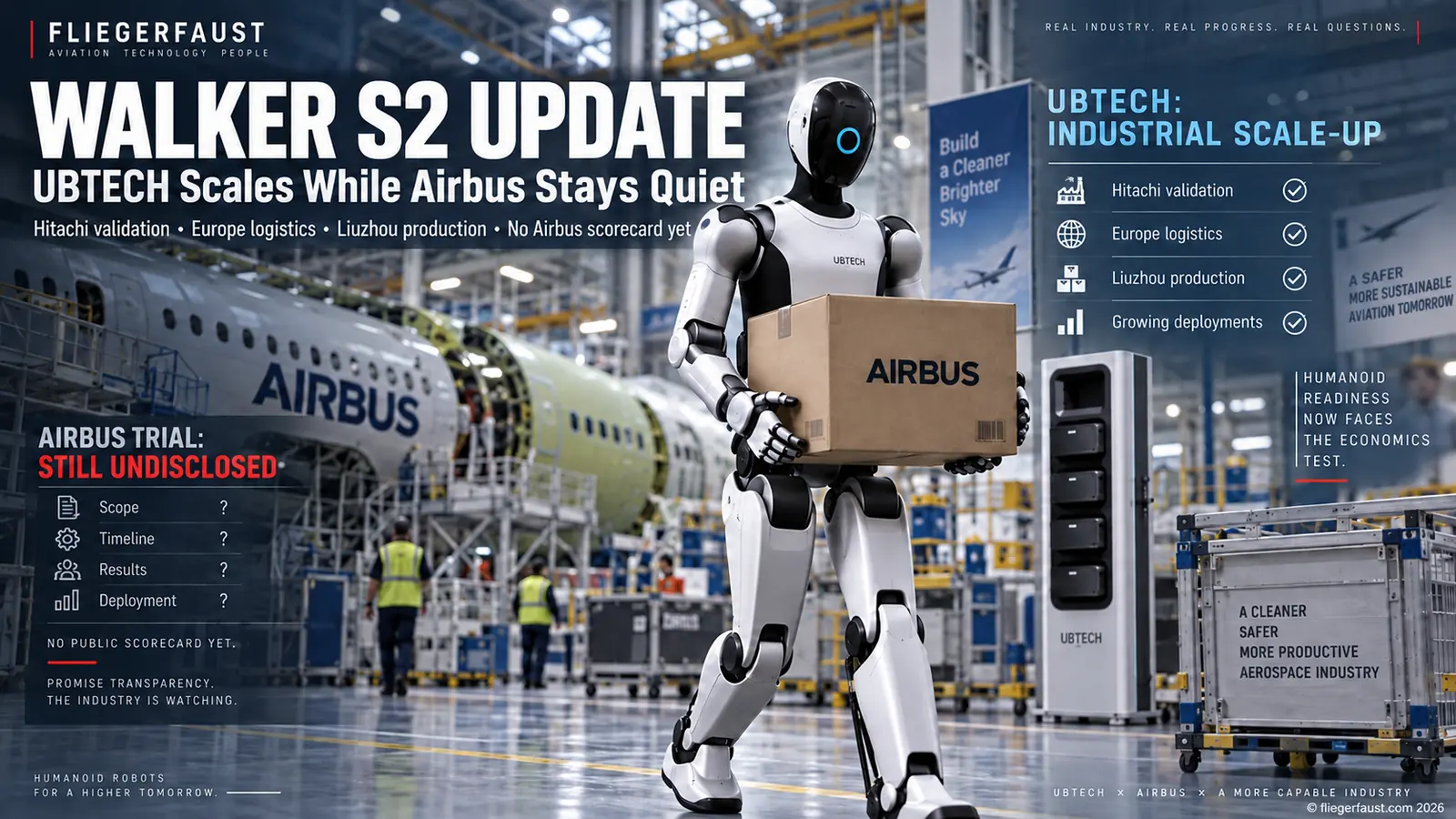
Walker S2 update: what has changed since Airbus began evaluating the Chinese humanoid robot, and what does the evidence now tell us about its industrial readiness? Since Fliegerfaust last examined the programme on April 18, 2026, Airbus has disclosed almost nothing new about its trial. UBTECH Robotics, however, has moved quickly around it.
The Chinese manufacturer has put Walker S2 into more specific factory validation with Hitachi. It has also expanded into European logistics through Terra Robotics and ROSSMANN. Meanwhile, humanoid revenue and sales volume have risen sharply, and a new Liuzhou factory has entered production.
UBTECH has even disclosed development of a fourth-generation industrial humanoid. At the centre of this technology is embodied artificial intelligence: AI operating through a physical machine that can perceive its surroundings and translate decisions into actions. Walker S2 combines AI with cameras, sensors, autonomous navigation and human-like manipulation.
That distinction is central to the Airbus experiment. Walker S2 is not simply another factory robot with legs and arms. UBTECH is betting that AI can make a human-shaped robot adaptable enough to perform different jobs in workspaces originally designed around people. Yet new company data and independent reporting also expose the technology’s remaining limitations. For aerospace, the story has therefore shifted from whether an AI-powered humanoid can enter a factory to whether it can deliver repeatable industrial results.
Walker S2 update: Airbus trial remains unusually quiet
When our April 18 Fliegerfaust Walker S2 analysis was published, Airbus’ latest authoritative description still placed the project at an early concept-testing stage. The company had not identified the trial site, aircraft programme or production task.
Airbus had also disclosed no robot quantity beyond the reported purchase. Contract value, evaluation schedule and decision criteria remained unknown. Most importantly, there were no published productivity or quality results.
Nearly six months later, those central questions remain unanswered. As of October 1, 2026, Fliegerfaust found no authoritative Airbus or UBTECH disclosure identifying the Walker S2 trial site, production task, performance results or follow-on deployment. Airbus and UBTECH have not publicly said whether the evaluation has progressed, stalled or ended. Humanoid robots may walk like people, but industrial evidence still has to stand on its own two feet.
Walker S2 still lacks an Airbus scorecard
The distinction matters because our original Fliegerfaust report on Airbus and UBTECH deliberately separated confirmed information from plausible applications.
Material handling, kitting, inspection and tool presentation all make sense for a mobile humanoid. However, Airbus never identified them as Walker S2 trial tasks. Claims that the robot was drilling or riveting aircraft were even less substantiated.
Airbus has released no Walker S2 cycle time, uptime or intervention rate since April 18. Nor has it published a first-pass success rate, quality metric or comparison with a human operator.
Airbus has not publicly described the robot’s safety architecture for the trial, including its collaborative zone, emergency-stop arrangement or fall-containment strategy.
The autonomy question also remains open. Airbus has not said whether its Walker S2 operates autonomously, through supervised autonomy, scripted routines or teleoperation.
For an aerospace factory, those are not academic distinctions. They determine whether a robot is an industrial tool, a development platform or an impressive demonstration that still needs substantial human support.
Airbus publishes numbers for other robots
Airbus’ own post-April robotics disclosures provide a useful benchmark. The company has not suddenly become silent about factory automation in general.
The clearest example is CabinMarker, a four-kilogram mobile robot developed by Airbus Robotics. Airbus reported in June 2026 that CabinMarker automates seat-position marking inside aircraft cabins.
An operator requires about 150 minutes to complete the task manually. Airbus says the robot can reduce that time to roughly 30 minutes.
Moreover, Airbus identified where the technology is going. Two CabinMarker units are scheduled for the Jean-Luc Lagardère A321 final assembly line in Toulouse during late 2026.
The company has also tested the system for possible use on the A330 line. Therefore, Airbus has disclosed the robot’s job, measured benefit, deployment quantity, production programme and location. That is almost the inverse of the Walker S2 story.
Walker S2 update: UBTECH advances beyond the Airbus trial
While Airbus has remained quiet, UBTECH has accumulated more substantial industrial references elsewhere. The most relevant development for aerospace readers involves Hitachi.
On July 13, 2026, UBTECH announced a strategic partnership with Hitachi. The company said Walker S2 had entered selected manufacturing environments for operational testing and application validation.
More specifically, Hitachi China Research Institute, UBTECH and Hitachi Elevator began secondary development on an elevator manufacturing floor.
UBTECH said the programme had progressed into substantive validation, including on-site operational testing and secondary development at a Hitachi Elevator manufacturing facility. That assessment comes from UBTECH rather than an independently published performance study. Nevertheless, the Hitachi programme provides something the Airbus story still lacks: an identified manufacturing environment and a stated validation activity.
Hitachi gives Walker S2 a more concrete factory test
The Hitachi work matters because elevator manufacturing presents many of the problems that make humanoids attractive. Production involves varied components, human-oriented workspaces and tasks that may not justify dedicated fixed automation.
UBTECH has not published detailed Hitachi performance figures. There is no disclosed cycle-time comparison, autonomous success percentage or interventions-per-shift figure.
The programme should not be confused with proven production economics. It is better evidence of industrial validation, but validation is still the operative word.
Even so, the comparison with Airbus is notable. UBTECH publicly identifies the Hitachi Elevator manufacturing floor and says secondary development is taking place there. No comparable detail has emerged about Airbus.
For aerospace, this distinction is useful. A robot does not become production-ready because another manufacturer lets it onto the factory floor. Still, every structured industrial trial gives UBTECH more data on manipulation, navigation and human-machine interaction. The robot business has acquired an old manufacturing lesson: eventually, the glamorous prototype has to meet the shift supervisor.
Walker S2 reaches European logistics
UBTECH announced another important development on July 13. The company disclosed a partnership with Terra Robotics covering Germany, Switzerland and Austria.
Terra purchased an initial batch numbering several dozen full-size UBTECH humanoids. The figure does not mean that every robot was a Walker S2 or that several dozen S2 units went to one ROSSMANN site.
However, the announcement specifically says Walker S2 is being used in ROSSMANN logistics operations. UBTECH identifies repetitive material handling and sorting among the applications.
The deployment therefore gives Walker S2 a useful European reference. It also places the machine in a setting where repetitive movement and material flow can generate large volumes of operational data.
Still, warehouse logistics is not aircraft manufacturing. Moving goods through a logistics centre imposes different requirements from working near conforming aircraft structures, calibrated tooling or controlled aerospace processes.
For Airbus, the relevance lies in the fundamentals. Reliable picking, transport, navigation and recovery must work before more demanding aircraft-production applications become credible.
UBTECH Walker S2 becomes a much larger business
The strongest post-April evidence of UBTECH’s changing scale comes from its financial disclosures. On August 28, the company published results for the six months ending June 30, 2026.
According to UBTECH’s filing with Hong Kong Exchanges and Clearing, total group revenue reached 1.2691 billion Chinese renminbi (RMB). That represented growth of 104.2% from the first half of 2025.
Full-size embodied-intelligence humanoid products and services generated RMB590.3 million. A year earlier, that category produced only RMB38.2 million.
The Chinese renminbi/yuan (RMB/CNY) is trading (October 2, 2026) at roughly:
- US$1 = RMB 6.705
- RMB 1 = US$0.1492
- RMB 100 = about US$14.92
- US$100 = about RMB 670.50
Sales volume in the category reached 921 units, compared with 45 during the first half of 2025. Those numbers show rapid commercialization, but they require an important qualification.
The 921-unit figure is not 921 Walker S2 robots
UBTECH’s 921-unit number covers its broader full-size humanoid category, which includes several platforms and application classes. It is not a Walker S2-only sales figure.
The RMB590.3 million revenue category also includes different products and services, with configurations varying between customers and applications. Dividing that revenue by 921 units would therefore not produce a valid Walker S2 selling price.
Meanwhile, UBTECH remained loss-making. The company reported a first-half loss of RMB338.8 million, although that was narrower than the corresponding 2025 loss.
The financial picture is therefore more nuanced than the shipment growth suggests. UBTECH is scaling humanoid commercialization quickly, but it is still spending heavily to build the technology and market.
For Airbus, that scale can be advantageous. A supplier producing hundreds of full-size humanoids has more opportunity to collect operational data and improve hardware.
However, volume alone cannot solve aerospace qualification. Ten thousand robots repeating an unreliable task would merely create a very efficient way to produce ten thousand headaches.
Walker S2 update: production capacity moves beyond promises
UBTECH’s production story has also changed materially since April. Our previous report noted annualized full-size humanoid capacity above 6,000 units at the end of 2025.
On September 12, 2026, a new manufacturing facility entered production in Liuzhou, Guangxi. Liuzhou municipal authorities reported that the plant is designed to produce Walker S-series and Cruzr-series robots.
The facility covers approximately 14,000 square metres. Authorities say the factory is designed to produce more than 10,000 robots annually, with its production line engineered to complete one robot approximately every ten minutes at full operating pace.
Those figures represent a significant industrial step. However, they describe planned capacity and production design, not 10,000 completed Walker S2 deliveries.
A 10,000-unit factory is not 10,000 deliveries
That distinction is essential when assessing China’s rapidly expanding humanoid sector. Factory capacity, production output, customer deliveries and robots performing productive work are four different measurements.
Moreover, the Liuzhou figure covers Walker S-series and Cruzr-series machines. It cannot be presented as annual capacity for 10,000 Walker S2 robots alone. Guangxi government reporting says the facility uses industrial simulation, plant-wide digital scheduling and UBTECH’s own embodied-intelligence robots in production operations. UBTECH is effectively using robotics to manufacture more robots. Henry Ford might recognize the production logic, although the workers now occasionally recharge themselves.
Still, the plant converts an earlier production ambition into physical manufacturing infrastructure.
For Airbus, manufacturing scale reduces one potential obstacle. A successful aerospace trial would be more commercially relevant if the supplier can produce machines consistently and support a growing installed base.
Yet scale introduces another challenge. UBTECH must demonstrate that quality, reliability and software maturity can rise alongside production volume.
Walker S2 update: autonomy gets a measurable benchmark
UBTECH’s August 28 financial filing contained one of the most useful technical disclosures since our April report. The company provided a numerical result for its industrial artificial-intelligence work.
UBTECH has been developing a Vision-Language-Action (VLA) system for industrial manipulation. VLA technology links what the robot sees and the instructions it receives with the physical actions needed to perform a task.
This AI layer is central to the humanoid proposition. Conventional factory robots generally execute tightly engineered and programmed processes. Embodied AI instead aims to let a robot perceive changing surroundings, interpret an assigned task and determine the physical actions needed to complete it. In principle, that could allow one Walker S2 to learn and perform several jobs instead of requiring a purpose-built robot for each process.
For Airbus, that flexibility could be the real prize. It is also the harder technical problem: an aerospace manufacturer needs the AI to behave predictably, recognize errors and recover safely when the physical world differs from its training data.
The company reported a 75% laboratory success rate in loading and unloading experiments. UBTECH’s interim results describe the work as preliminary validation of generalization from controlled conditions toward more dynamic industrial environments.
That is genuine technical information. It is also a useful reminder of how carefully humanoid performance numbers must be read.
Seventy-five per cent does not mean 75% productivity
The laboratory result measures something different from UBTECH’s earlier estimate that Walker S2 achieved 30% to 50% of human productivity on selected tasks. That earlier figure compared productivity on activities such as box stacking and quality inspection, while the new 75% figure measures success in a specific laboratory loading and unloading experiment.
The two benchmarks therefore describe different aspects of performance and do not represent a progression from 50% to 75% of human performance.
For aerospace, the 75% result nevertheless provides useful perspective. Aircraft manufacturing requires predictable process control, especially when a machine operates near valuable structures, tooling or conforming parts.
A failed manipulation does not necessarily create a defective aircraft. Good automation detects errors, stops safely and recovers correctly. However, Airbus has disclosed none of those Walker S2 metrics.
The interesting number is therefore not merely successful attempts. It is how the system handles the unsuccessful ones.
Reuters finds humans still deep in the loop
An independent investigation published one day earlier supplied a broader reality check. Reuters examined China’s humanoid robotics industry on August 27 and found persistent challenges involving dexterity, autonomy, training data and economics.
At an embodied-artificial-intelligence training facility in Guangxi, Reuters observed more than 100 humanoids being teleoperated by human trainers. The centre had received robots through a government tender involving UBTECH.
Teleoperation helps developers gather examples of successful physical actions. Those datasets can then train artificial-intelligence models to perform tasks with less human involvement.
Instead, the investigation shows how much human work can sit behind increasingly capable humanoid systems. The robot may be learning to work alone, but somebody still has to teach the new employee where the parts bin is.
The next UBTECH industrial humanoid is already coming
Perhaps the most consequential technical disclosure since April does not concern Walker S2 directly. UBTECH says it has already developed a fourth-generation industrial embodied-intelligence humanoid.
UBTECH did not provide a commercial model name for the fourth-generation machine in its August filing.
According to UBTECH’s August 28 disclosure, the new generation improves onboard computing, perception and operational precision. The company also reports greater leg-joint movement.
Furthermore, UBTECH says the design cuts total robot weight by more than 15%. It attributes part of that reduction to what it describes as aerospace-grade lightweight materials.
Battery swapping gets faster again
The new robot also reduces battery replacement time to two minutes, according to UBTECH. Walker S2’s autonomous battery exchange takes roughly three minutes.
That one-minute improvement sounds modest. In high-utilization industrial operations, however, accumulated downtime can affect the economic case across many machines and shifts.
More importantly, the disclosure demonstrates how quickly UBTECH’s hardware roadmap is moving. Airbus may still be evaluating Walker S2 while its manufacturer prepares a more advanced industrial generation.
That does not automatically make the current machine obsolete. Industrial customers routinely qualify one generation while suppliers develop another.
However, aerospace qualification can move slowly. Hardware and software changes must therefore be controlled carefully if Airbus eventually identifies a production application.
The timing creates an interesting problem. A humanoid platform may evolve faster than an aerospace manufacturer can validate it. Silicon Valley calls that iteration; a production engineer may call it another stack of paperwork.
UBTECH expands the industrial ecosystem around Walker S2
UBTECH is also building partnerships around components, distribution and overseas deployment. Those relationships matter because industrial robots require much more than a clever mechanical platform.
On August 19, BASiC Semiconductor disclosed strategic cooperation with UBTECH. The companies plan to develop high-performance, high-reliability silicon carbide (SiC) power-device solutions for embodied-intelligence humanoids, including power-management and motion-control applications.
Power electronics influence efficiency, thermal performance and actuator control. Those factors become increasingly important as humanoids carry heavier loads and work longer shifts.
Meanwhile, the Hitachi and Terra Robotics agreements provide integration routes into different industrial environments. Together with the BASiC Semiconductor component partnership, the emerging strategy looks less like selling individual robots and more like constructing an industrial ecosystem around embodied artificial intelligence.
Europe offers a useful proving ground
The Terra Robotics relationship is particularly relevant because European deployment introduces another layer of expectations. Industrial customers must consider machinery safety, integration, worker interaction and data governance.
Moreover, machinery placed on the European Union market before January 20, 2027, must comply with Machinery Directive 2006/42/EC, which requires the manufacturer or its authorised representative to carry out a risk assessment and meet applicable essential health and safety requirements. A humanoid’s flexibility does not exempt it from conventional industrial safety principles.
That point becomes more important as UBTECH promotes continuous operation. Walker S2’s dual-battery architecture can reduce charging interruptions, but uninterrupted energy does not equal uninterrupted productive uptime.
Mechanical reliability, software faults, task failures and human interventions still matter. UBTECH has not published a Walker S2 mean time between failures for the Airbus trial.
Consequently, UBTECH’s continuous-operation claim should be understood as a design proposition rather than an independently verified Airbus availability figure. Batteries can keep the lights on; they cannot guarantee that the robot knows what to do next.
Airbus humanoid robot raises a new data-security question
The Walker S2 update also intersects with another Airbus priority: control over artificial-intelligence systems and sensitive industrial information.
On May 28, Airbus announced a strategic partnership with Mistral AI. Airbus emphasized strict security and sovereignty requirements for artificial-intelligence applications, including highly confidential aerospace uses.
That announcement did not concern UBTECH. However, it establishes relevant context for any vision-equipped humanoid operating inside an aircraft factory.
Walker S2 relies on cameras, sensors, computing and software to perceive its environment. Industrial learning systems may also generate valuable operational data during training and execution.
Where does the factory data go?
For Airbus, the obvious questions concern where those data are processed and retained. The company has not publicly described the Walker S2 trial’s network architecture or said whether imagery remains entirely within Airbus-controlled infrastructure.
Airbus has also not disclosed whether UBTECH can remotely access diagnostics, telemetry or training information from the evaluation. Those questions matter because cameras operating inside an aerospace production environment can see far more than the component the robot was asked to pick up.
For a manufacturer protecting designs, processes and production data, cybersecurity may prove as important as dexterity. A robot that remembers everything it sees needs an equally good lesson in discretion.
Walker S2 update: Airbus keeps expanding robotics without Walker
The absence of new Walker S2 details becomes more significant when viewed against Airbus’ wider industrial activity. Airbus has continued to announce automation projects, production investments and robotics initiatives since April.
On May 20, Airbus launched a new technology hub in Mirabel, Quebec. The Airbus Tech Hub in Canada will support the A220 and future aircraft programmes.
Manufacturing and operations form one of its three main technology pillars. Airbus specifically identifies artificial intelligence, industrial robotics and digital twins as tools for the A220 production ramp-up.
That announcement is relevant because it confirms that Airbus continues to investigate new industrial robotics applications. Yet the company made no connection between the Canadian programme and Walker S2.
Toulouse adds more automated production
Airbus also inaugurated its second modernized A320 Family final assembly line in Toulouse on June 15, 2026. The facility supports the manufacturer’s production ramp-up toward 75 A320 Family aircraft per month.
The new Airbus Toulouse line incorporates digital controls, automated logistics and robotics. Airbus says those technologies improve workflows and workstation ergonomics.
However, the announcement does not identify Walker S2. That is important because Toulouse has repeatedly appeared in secondary speculation about the humanoid trial.
Airbus clearly operates advanced robotics there. That fact alone does not establish that its UBTECH machine is there.
Meanwhile, Airbus has demonstrated that it will name technologies when appropriate. CabinMarker received a site, production programme, performance result and deployment timetable. Walker S2 still has none of them publicly.
The mystery therefore belongs specifically to the humanoid evaluation, not to an Airbus-wide allergy to talking about robots. Even industrial secrecy has its favourite children.
Tianjin advances without a public Walker S2 connection
China provides another important industrial backdrop. On September 16, Airbus delivered the first aircraft assembled on its second A320 Family final assembly line in Tianjin.
The Airbus Tianjin announcement described the new line as an important part of the company’s global production system. The first aircraft from the facility was an A320neo for China Eastern Airlines.
Airbus has operated its original Tianjin final assembly line since 2008. More than 800 A320 Family aircraft had been assembled and delivered there by the September announcement.
Yet Airbus again made no public connection between Walker S2 and the Tianjin expansion. Therefore, the Chinese origin of UBTECH should not be used to infer a Tianjin deployment.
What the expansion does show is the scale of the industrial environment surrounding the trial. Airbus is adding production capacity while introducing digital systems and robotics across several sites.
A humanoid that wants a place in that network must compete against established automation, mobile platforms and conventional industrial equipment. Being able to climb the metaphorical corporate ladder is not enough; it needs a useful workstation at the top.
What the Walker S2 update actually tells us
Six months of new evidence have changed the UBTECH side of the story considerably. They have changed the Airbus side much less.
Walker S2 now has a more concrete manufacturing-validation programme with Hitachi. It also has a European logistics reference through Terra Robotics and ROSSMANN.
UBTECH’s full-size humanoid business has grown rapidly. Revenue reached RMB590.3 million during the first half of 2026, while category sales volume reached 921 units.
Meanwhile, the Liuzhou factory gives the company’s production ambitions a physical base. Planned annual capacity above 10,000 robots is substantially different from producing prototypes in small batches. However, none of those developments proves that Walker S2 meets Airbus’ production requirements.
Industrial scale and industrial readiness are different
That distinction should remain central to any assessment of humanoid robotics. Manufacturing thousands of robots proves that a company can industrialize its product. It does not prove that every customer can industrialize the robot’s work.
Aerospace creates an especially demanding test. Production processes require repeatability, traceability and controlled changes. A mistake can damage expensive components even when it does not create an airworthiness issue.
Additionally, aircraft factories contain many tasks that conventional automation already performs extremely well. Airbus’ drilling robots and CabinMarker demonstrate that specialized machines can deliver clear results without resembling human workers.
A humanoid therefore needs to justify its additional mechanical complexity. Legs, dexterous hands and generalized perception become valuable only when they unlock enough flexibility to offset their cost and limitations.
This is where Walker S2 remains interesting. A human-scale machine can potentially use existing aisles, tools and workstations without extensive factory reconstruction.
However, potential flexibility is not the same as productive flexibility. The decisive test is whether the robot can move between useful tasks without requiring lengthy reprogramming, retraining or human intervention.
UBTECH’s 75% laboratory result suggests progress toward that goal. Reuters’ reporting shows why the final stretch remains difficult.
The Airbus trial could still be one of UBTECH’s most important tests
Airbus may therefore provide a more meaningful benchmark than a spectacular public demonstration. Aircraft production exposes weaknesses that carefully staged robot videos can hide.
A useful Walker S2 would need to navigate reliably around workers and valuable structures. It would also need predictable manipulation, controlled failure modes and robust recovery procedures.
Furthermore, Airbus would need to understand the economic case. A humanoid working continuously can still lose to a human or specialized robot if its cycle time remains poor.
The same applies to intervention rates. A machine that needs frequent assistance simply transfers labour rather than eliminating the problem.
Consequently, the most valuable Airbus data would be surprisingly ordinary: productive hours per shift, successful tasks per hour, interventions, safety stops, faults and cost per completed operation.
Those figures would tell aerospace manufacturers far more than another video of a robot walking through a factory. The future of industrial robotics will probably be decided in spreadsheets long before it is decided in science-fiction comparisons.
UBTECH Walker S2 now faces the economics test
UBTECH’s rapid expansion also changes the commercial question. The company no longer needs only to prove that Walker S2 can perform industrial tasks. It must increasingly prove that customers can earn a return from those tasks.
The first-half results show strong revenue growth, but UBTECH still reported a substantial loss. That is not unusual for a company funding aggressive development and expansion.
However, sustained industrial adoption will eventually depend on customer economics rather than investor tolerance. Factories will compare humanoids with workers, automated guided vehicles, autonomous mobile robots and conventional robot arms.
Flexibility must justify the complexity
Walker S2’s strongest proposition is not raw payload. Its advantage lies in combining mobility, manipulation and a human-compatible physical form.
That combination could make the robot attractive for low-volume or frequently changing work. Aerospace contains many such tasks because production volumes remain modest compared with automotive manufacturing.
Additionally, aircraft factories contain legacy workspaces designed around people. Rebuilding every station for fixed automation can be expensive.
A humanoid could potentially work inside that existing infrastructure. If software allows one machine to perform several jobs, utilization could improve further.
Yet every added capability introduces another potential failure mode. Bipedal locomotion is mechanically more complicated than wheels, while dexterous manipulation remains difficult.
Therefore, the economic contest will not simply be robot versus worker. It will often be humanoid versus a cheaper machine built for one job.
That may ultimately determine where Walker S2 belongs. The best humanoid application could be the task for which nobody can justify building a specialized robot.
Conclusion: Walker S2 update now needs Airbus numbers
Conclusion: Walker S2 update now needs Airbus numbers
Since our April 18 report, the Walker S2 story has moved well beyond the novelty of Airbus experimenting with a Chinese humanoid. UBTECH is increasingly turning Walker S2 into an industrial platform built around embodied artificial intelligence (AI). Hitachi is validating the robot in manufacturing, Walker S2 has entered European logistics with ROSSMANN, and UBTECH is expanding the production system behind its humanoid business.
The scale is becoming significant. Full-size humanoid products and services generated RMB590.3 million in the first half of 2026, while UBTECH reported 921 units across that broader category. Its Liuzhou factory in China is designed for annual production above 10,000 robots across relevant product families, and the company is already developing a fourth-generation industrial humanoid.
The bigger bet is embodied AI
However, the most important development is not simply that UBTECH can build more humanoid robots. The real bet is that AI can make a human-shaped machine adaptable enough to perform useful physical work across different industrial tasks. Walker S2 combines perception, navigation and manipulation with an evolving AI stack designed to turn what the robot sees and understands into physical action.
UBTECH’s reported 75% laboratory success rate for Vision-Language-Action loading and unloading work provides a useful measure of that progress. It also shows why the next phase matters: industrial AI must move from successfully performing learned tasks under test conditions to handling changing factory environments reliably, safely and economically.
Airbus could provide the aerospace test
This is where Airbus becomes especially relevant. Aerospace offers exactly the kind of environment where a humanoid’s flexibility could have value: complex products, relatively low production volumes, human-oriented workspaces and many tasks that are difficult to justify automating with a dedicated machine that is not using AI. Walker S2 does!
At the same time, Airbus already has specialized robots that perform defined jobs efficiently. Walker S2 therefore has to offer something more compelling than a human shape. Its AI, mobility and manipulation must make the robot flexible enough to justify the additional complexity. Airbus has yet to publish the results of its evaluation, leaving that aerospace test as the important missing piece.
UBTECH has nevertheless moved the story forward considerably since April. Walker S2 is gaining industrial experience, humanoid production is scaling, and embodied AI is becoming more capable. The question is no longer whether China can build a humanoid robot that walks through a factory. It is whether that combination of AI and human-shaped hardware can become a productive industrial tool.
Walker S2 has learned how to change its own batteries, while UBTECH is learning how to manufacture AI-powered humanoids at scale.
Airbus may now help answer the question that matters most: can embodied AI make a humanoid genuinely useful in aircraft production, or will specialized machines continue to do the job better?
Leave your comments below and on our Fliegerfaust Facebook page.
Sources
- Reuters — UBTech agrees Airbus deal to expand robot use in aviation manufacturing (January 21, 2026).
- Financial Times — Robots only half as efficient as humans, says leading Chinese producer (January 25, 2026).
- UBTECH Robotics — UBTECH and Hitachi Enter into Strategic Partnership to Jointly Explore Intelligent Solutions Across Multiple Fields (July 13, 2026).
- UBTECH Robotics — UBTECH partners with collaborators to accelerate global expansion, Bringing humanoid robots to European retail logistics environments (July 13, 2026).
- Hong Kong Exchanges and Clearing / UBTECH Robotics — Interim Results Announcement for the Six Months Ended June 30, 2026 (August 28, 2026).
- UBTECH Robotics — Interim Report 2026 (September 24, 2026).
- BASiC Semiconductor — Strategic Cooperation Between BASiC Semiconductor and UBTECH (August 19, 2026).
- European Union / EUR-Lex — Directive 2006/42/EC on machinery (accessed October 1, 2026).
- Reuters — China can build kung fu-fighting robots. But it can’t get them to do factory work (August 27, 2026).
- Liuzhou municipal authorities — UBTECH humanoid robot smart factory enters production in Liuzhou (September 14, 2026).
- Guangxi government — UBTECH’s 10,000-unit-scale industrial humanoid robot smart factory enters production in Liuzhou (September 13, 2026).
- Airbus — Meet the versatile Airbus robot automating aircraft seat installation (June 3, 2026).
- Airbus — Airbus establishes Tech Hub in Canada (May 20, 2026).
- Airbus — Airbus partners with Mistral AI to strengthen the use of artificial intelligence in sovereign aerospace applications (May 28, 2026).
- Airbus — Airbus inaugurates new A320 Family final assembly line in Toulouse (June 15, 2026).
- Airbus — Airbus delivers first aircraft from its second A320 Family Final Assembly Line in China (September 16, 2026).
- UBTECH Robotics — Walker S2 product information (accessed October 1, 2026).
For full details, please refer to our Disclaimer page.