


Bombardier and Saab: could the first Gripen E built outside Sweden offer a preview of how Saab intends to expand aerospace production with local partners—including Canada?
Two developments this week make that question more concrete. In Brazil, the first Saab Gripen E manufactured by Embraer completed its maiden flight on October 6, 2026. Meanwhile, reporting in Canada says Bombardier currently favours its Toronto Pearson operation over Quebec for a future Canadian Saab GlobalEye production facility.
The developments involve different aircraft and different programmes. Yet they share one industrial theme: Saab is increasingly using established national aerospace companies to expand production beyond Sweden.
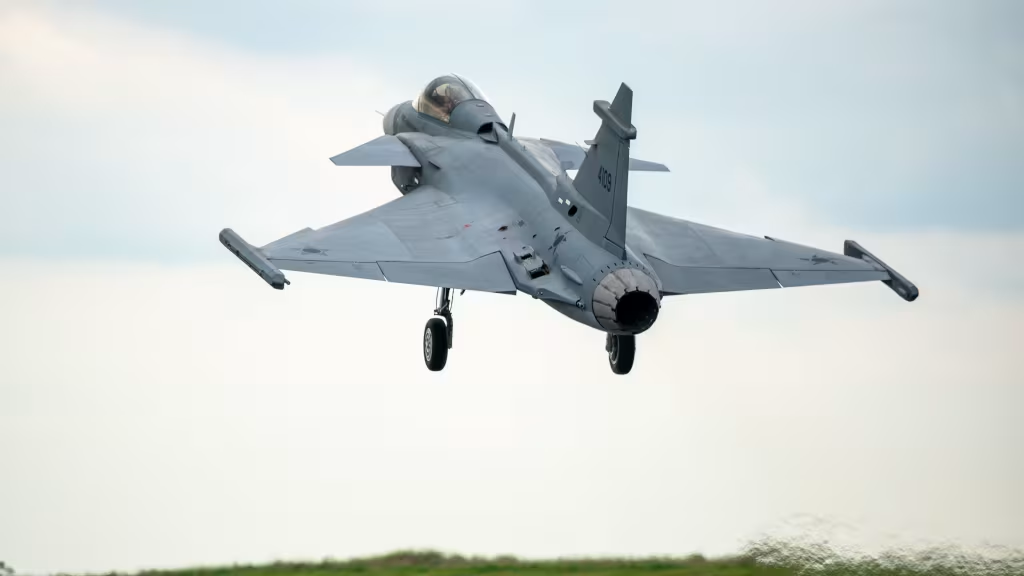
Gripen E built in Brazil takes its first flight
Saab announced on October 7 that the first Gripen E produced in Brazil had completed its maiden flight from Embraer’s Gavião Peixoto aerodrome in São Paulo State.
The aircraft departed on October 6 at 10:21 local time with Saab chief test pilot Jakob Högberg at the controls. The sortie checked basic aircraft systems and initial performance and served as the aircraft’s first production-acceptance flight.
The milestone is significant because this is the first Gripen manufactured outside Sweden. Embraer flight engineers handled flight planning and execution with Saab support, providing another practical result from the technology-transfer programme established between Sweden and Brazil.
“Gripen production in Brazil has reached a new level of maturity.” — Marcus Wandt, Head of Saab business area Aeronautics
The aircraft is the first of 15 Gripen E fighters scheduled to be produced in Brazil under the current programme. After completing its acceptance-flight campaign, it is expected to join the Brazilian Air Force at Anápolis Air Force Base.
Saab is building more than a token foreign assembly line
Brazil matters to the Canadian discussion because Saab’s localisation model is no longer theoretical.
Embraer’s Gavião Peixoto operation includes final assembly, testing and engineering participation, while Gripen aerostructures are also manufactured in Brazil. Saab describes Embraer as part of its global Gripen manufacturing and supply network.
The relationship could expand further. In July, Saab and Embraer signed a framework covering the potential production of 20 additional Gripen aircraft in Brazil. Saab said Embraer’s line could complement final assembly in Linköping and provide additional capacity for future global demand.
That is directly relevant to a subject Fliegerfaust has been following in Canada. Our Fliegerfaust coverage of the Bombardier–Gripen Canada production concept examined whether Saab could replicate elements of its Brazilian model with a major Canadian aerospace partner.
Our subsequent Fliegerfaust update on Bombardier, Saab and potential Canadian Gripen production followed that discussion as the industrial proposal moved further into the public record.
Brazil now provides something those discussions previously lacked: a Gripen built by Saab’s foreign industrial partner has actually flown.

Bombardier reportedly favours Ontario for Saab GlobalEye
The more immediate Canadian development concerns GlobalEye rather than Gripen.
The Globe and Mail reported this week, citing sources familiar with the discussions, that Bombardier currently favours expanding its Toronto Pearson facility for Canadian GlobalEye production.
The industrial logic is difficult to miss. Bombardier already builds the Global 6500 at Pearson. That aircraft becomes the platform on which Saab installs the radar, sensors, mission systems and other equipment that transform a business jet into the GlobalEye airborne early warning and control aircraft.
For a conventional Global 6500 business jet, Toronto is only the first stop. Bombardier says the aircraft is assembled at its Toronto facility and then completed at the Laurent Beaudoin Completion Centre in Montreal, where the highly customised business-jet cabin is installed. A GlobalEye does not require that luxury-interior completion. Instead, it needs a specialised mission interior and extensive military systems integration. That gives Pearson an important industrial advantage: a Canadian GlobalEye production stream could potentially take the basic aircraft directly from the Toronto assembly operation into special-mission modification, rather than first sending it to Montreal for the normal business-jet completion process. Bombardier’s Global 6500 documentation confirms the normal Toronto-assembly and Montreal-completion sequence.
According to the Globe report, Bombardier is seeking to settle on a production location around the end of 2026 or early 2027. An expansion at Pearson has been estimated at approximately $500 million, with construction potentially beginning in 2027.
However, Ontario has not won the project. The report says provincial incentives could still influence whether the work ultimately goes to Pearson or Dorval, Quebec. That introduces a new political variable. Official results from Élections Québec show the Parti Québécois won 59 seats in the October 5 election, leaving it to form a minority government. Quebec’s existing aerospace strategy already identifies aerospace as a strategic economic sector and includes strengthening security and defence among its priorities. Whether the incoming government chooses to use provincial incentives to compete with Ontario for GlobalEye work is now an open question.
That distinction matters. Bombardier may currently prefer Ontario for operational reasons, but the industrial competition is not finished.
Why Pearson has an obvious GlobalEye advantage
Bombardier opened its new Global manufacturing centre at Toronto Pearson in 2024. The approximately 770,000-square-foot facility was built specifically around final assembly of the Global family.
GlobalEye therefore presents a different industrial question from starting a completely new aircraft programme. Under the current production flow, the Global 6500 platform leaves Bombardier without conventional interior fittings and is flown to Saab’s Linköping facility in Sweden for military conversion and systems integration.
Keeping more of that transformation close to the existing Global assembly operation could simplify aircraft flow, workforce integration and logistics. It could also give Bombardier a larger share of the value created after the green aircraft leaves the conventional business-jet line.
Quebec nevertheless retains formidable aerospace advantages, including Bombardier facilities, engineering talent and a deep supplier base. The eventual location will therefore say something about how Bombardier intends to organize its growing defence business—not simply which province offers the largest cheque.
Canada GlobalEye negotiations are real, but no final contract exists
The factory discussion is advancing while Canada negotiates the aircraft itself.
On May 27, Canada selected Saab as the preferred supplier for its future airborne early warning and control capability. Ottawa was careful to state that the decision opened negotiations and did not constitute a procurement commitment.
Our Fliegerfaust coverage of Canada’s GlobalEye selection examined the significance for Arctic surveillance, the Royal Canadian Air Force (RCAF) and Bombardier’s Global 6500 industrial base.
The programme moved another step forward on September 25. Canada and Saab signed a non-binding term sheet establishing the framework for negotiations covering six GlobalEye aircraft, associated systems, training and support.
Our Fliegerfaust analysis of the six-aircraft GlobalEye framework examined what had become defined—and what still remained unresolved before a binding contract.
The factory-location discussion should therefore be read in the same way. It is becoming specific, but it has not yet become final.
GlobalEye production could extend far beyond six Canadian aircraft
A Canadian production line becomes considerably more interesting if its purpose extends beyond Canada’s proposed six aircraft.
NATO announced in July that 11 allies intend to jointly procure up to 10 Saab GlobalEye aircraft as part of the alliance’s future airborne surveillance capability. Canada is one of the participating countries.
That development followed a story Fliegerfaust had already been tracking in our coverage of the Bombardier–Saab GlobalEye opportunity for NATO.
The potential export market changes the economics of a Canadian facility. Tooling, mission-system integration capability and a specialised workforce become easier to justify if production can serve several customers rather than six Canadian aircraft alone.
That is also why the Ontario-versus-Quebec location decision matters more than a normal plant expansion. The winning site could become part of Saab’s international GlobalEye production network.
Brazil gives Saab’s Canadian industrial promises more weight
The Gripen and GlobalEye programmes should not be confused. One is a Saab fighter aircraft manufactured with Embraer; the other is a Saab surveillance aircraft built around Bombardier’s Global platform.
Yet Brazil establishes an important precedent.
Saab has transferred engineering knowledge, aerostructure work, final assembly and flight-test responsibilities to a foreign aerospace partner. The first Brazilian-built Gripen E has now passed the most visible test of that industrial strategy: it flew.
That does not prove Saab will build Gripen fighters in Canada.
What it does establish is that Saab’s model of producing sophisticated military aircraft with a major local aerospace company outside Sweden already exists in operational form.
For Canada, that makes the industrial discussion less hypothetical than it was when our earlier Bombardier–Gripen coverage began.
Conclusion: Ontario leads, Quebec is still in the race
The two developments tell a larger story about Saab’s manufacturing strategy.
Brazil has moved from technology-transfer promises to a locally produced Gripen E completing its first flight. Canada is at an earlier stage of a similar industrial path, moving from proposals toward decisions about facilities, workshare and production.
Bombardier’s reported preference for Pearson is understandable because the Global 6500 already comes off the line there.
The bigger question is what follows once a location is chosen. If Canada signs a final GlobalEye contract and a domestic line also gains export work, Saab and Bombardier could create an industrial partnership much larger than the initial six-aircraft requirement.
Brazil has now shown that Saab can put meaningful military-aircraft production in another country. If Bombardier ultimately chooses Ontario for GlobalEye, will that Brazilian model become the blueprint for Saab’s next major international production partnership?
Leave your comments below and on our Fliegerfaust Facebook page.
For full details, please refer to our Disclaimer page.