

Could 2027 turn years of airline interest into a programme decision?
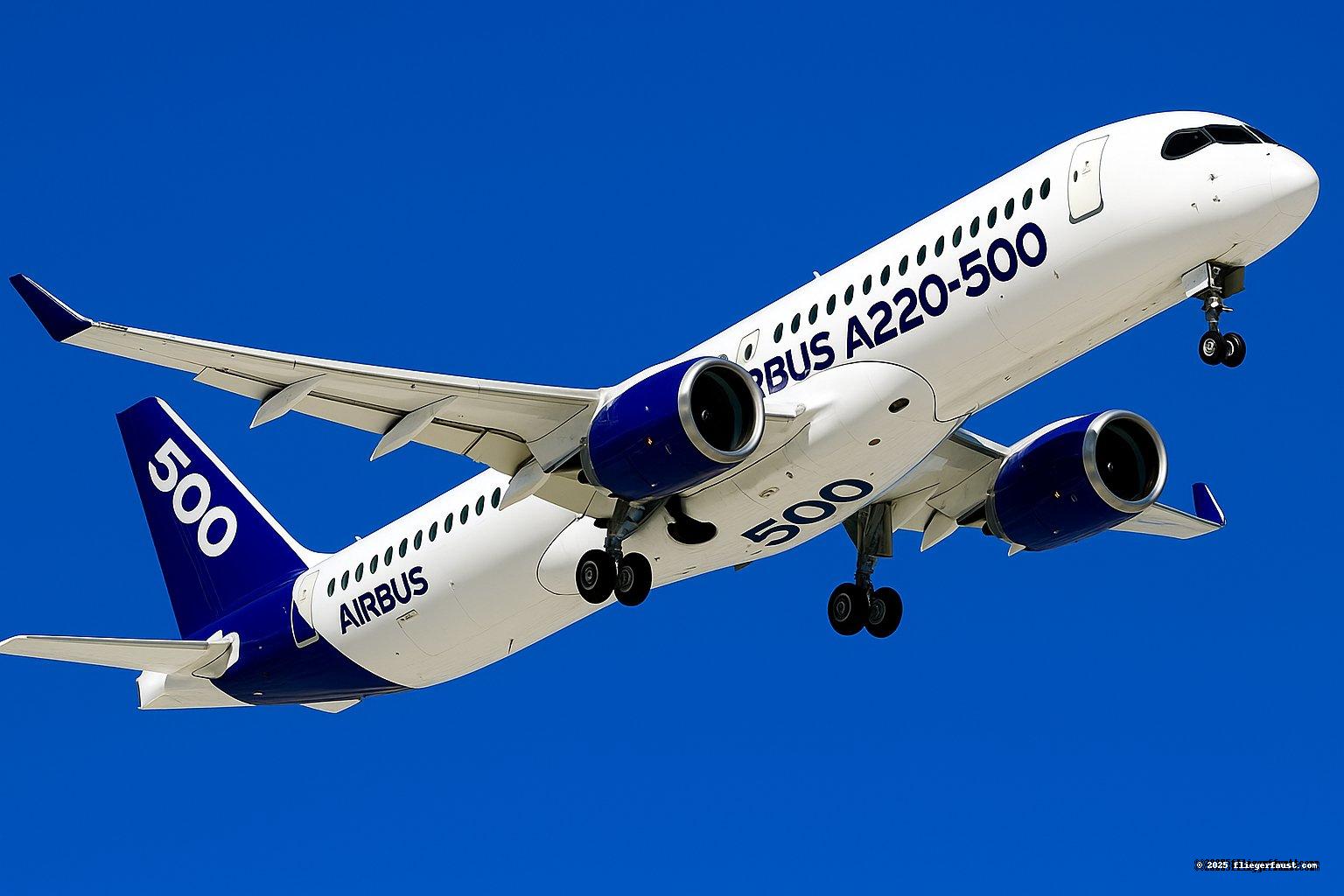
Airbus A220-500: Lars Wagner, chief executive of Airbus Commercial Aircraft, has identified 2027 for strategic decisions on stretched A220 (A220-500) and A350 variants. His November 18, 2026 interview in La Dépêche du Midi gives the proposed larger A220 a clearer decision horizon.
Airbus A220-500 moves towards a decision
Le Journal de l’Aviation’s November 20 report adds an indicative market-entry window around 2033 for both stretches. It says meeting that objective would require decisions within approximately twelve months.
Airbus has yet to authorise either programme. During the Airbus analyst call on October 28, chief executive Guillaume Faury described work on customer requirements, supplier capability and the business case. Alongside the potential A350-2000 stretch, Airbus is studying additional A350 production capacity. Faury highlighted strong demand for that family.
Airlines had already raised range concerns when a potential 2026 launch was under discussion. Our Fliegerfaust coverage of the A220-500 launch debate examines how those questions and lessor feedback shaped the proposal.
The new timing gives customers a more specific period to watch for an answer. The airshow calendar has never been the toughest engineering requirement.
Airbus A220-500: the wing and range question
More seats would spread flight costs across additional passengers. The engineering question is how much aircraft Airbus must change to deliver that advantage while meeting customers’ range requirements.
Our Fliegerfaust analysis of the A220-500’s wing and engine choices examines that trade-off. A longer fuselage adds structural weight, passengers and baggage, affecting the balance between payload, fuel and take-off performance.
For reference, Airbus’s June 2026 technical data lists 3,400 nautical miles for the A220-300. The stretch’s eventual payload–range performance would depend on the design Airbus chooses.
Retaining more of the existing design could limit development costs and preserve fleet commonality. More extensive changes could protect performance while increasing investment and certification work. The wing still has a vote in the seating plan.
Faury identified engine selection as central to aircraft performance and the business case. Airbus has not published a final wing, engine or range specification for the proposed stretch.
Airbus A220-500 demand meets production reality
Air France supplies a clear example of the demand. In La Tribune’s November 9 report, A220 fleet head David Hoch confirmed the airline was pushing Airbus for more capacity. The newspaper describes a potential 180–185-seat version; that remains a proposal rather than an approved specification.
Our Fliegerfaust report on Air France’s expanding A220 fleet explains the purchasing and operating economics behind that interest. Hoch said the existing aircraft had made marginal or unprofitable routes profitable.
AirAsia also sees a future stretch with more than 180 seats as an A320 successor, according to AirAsia’s May 6 announcement. Its firm commitment covers 150 A220-300s, the launch order for the 160-seat configuration.
Our Fliegerfaust coverage of 160-seat A220-300 certification and the stretch examines the reported 2028 certification target and the production challenge. Airbus’s announcement specifies an extra overwing emergency exit on each side for 160 seats. That configuration retains the existing fuselage length.
Airbus’s October 28 financial results reaffirmed its target of 13 A220s per month in 2028. A larger derivative would draw on that industrial base. Airline wish lists grow faster than assembly lines.
Conclusion: A clearer calendar, with the design still open
Wagner has given the stretch debate a clearer decision point. The reported 2033 objective also shows the development horizon beyond a possible launch. Customers need the eventual combination of capacity, range, price and delivery availability to fit their networks.
For Airbus, the opportunity is to turn established demand for more seats into a product with a viable business case. That means matching the added capacity to routes airlines can operate profitably. The extra rows still have to earn their keep.
Will the Airbus A220-500 emerge from 2027 with an approved programme and the performance airlines need to commit?
Leave your comments below and on our Fliegerfaust Facebook page.
Sources
- La Dépêche du Midi — Entretien. « Nous allons réaliser une performance industrielle exceptionnelle »… (November 18, 2026).
- Le Journal de l’Aviation — La fenêtre de lancement des Airbus A220 et A350 allongés se précise (November 20, 2026).
- Airbus — Nine-month 2026 earnings release analyst call transcript (October 28, 2026).
- Airbus — A220 Facts and Figures (June 2026).
- La Tribune — Airbus A220 : le pari gagnant d’un moyen-courrier ultra rentable pour Air France (November 9, 2026).
- AirAsia — AirAsia X (AirAsia Group) makes history with record order for 150 Airbus A220s… (May 6, 2026).
- Airbus — AirAsia places landmark order for 150 A220s (May 6, 2026).
- Airbus — Airbus reports Nine-Month (9m) 2026 results (October 28, 2026).
For full details, please refer to our Disclaimer page.