
Canada’s first F-35 has flown—what comes next for the fleet and the Canadian companies behind it?
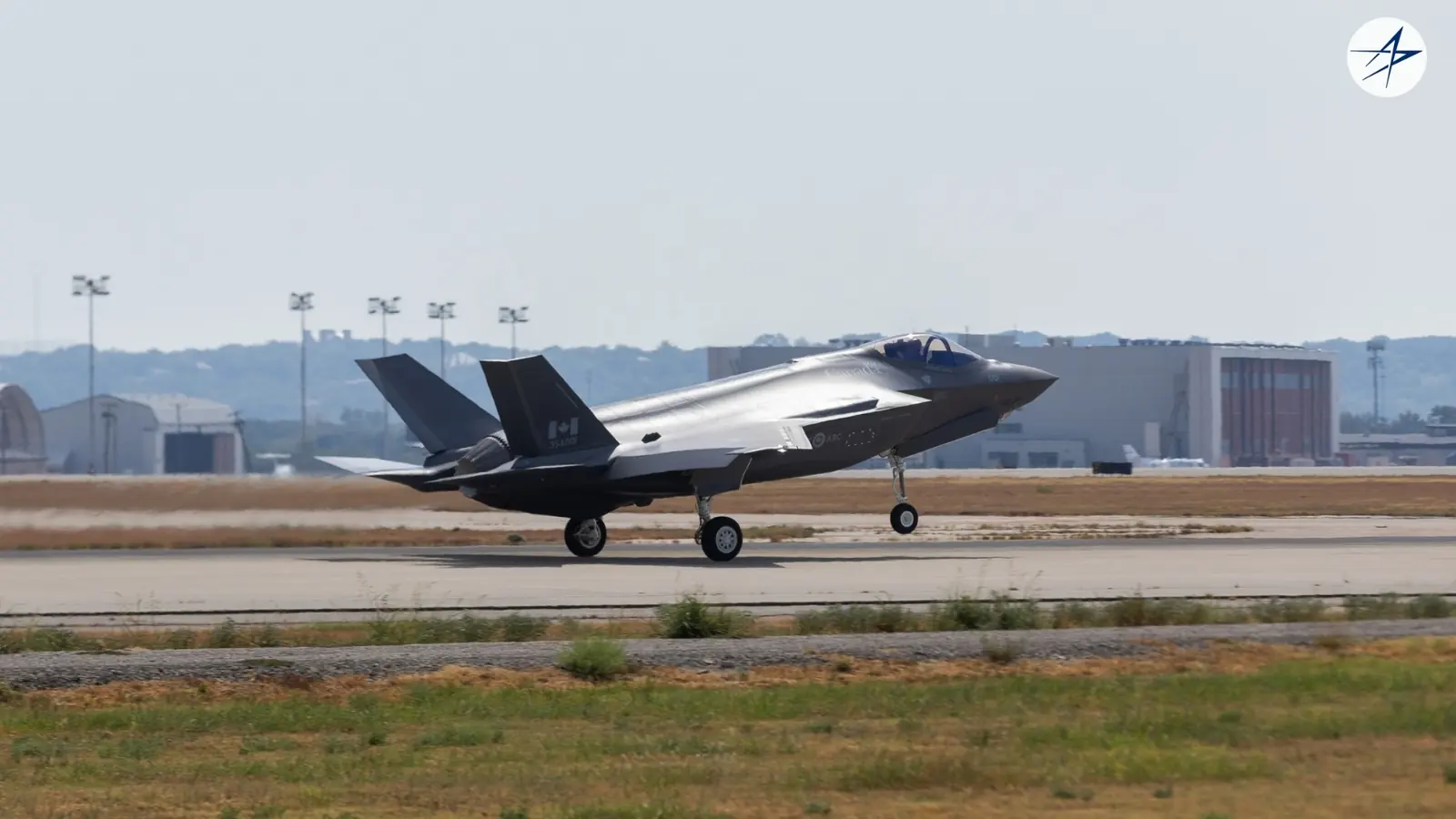
The first Lockheed Martin F-35A Lightning II built for Canada completed its maiden flight on September 23, 2026. Aircraft AR-1 departed Naval Air Station Joint Reserve Base Fort Worth, Texas, beside the manufacturer’s assembly complex. The Aviationist documented the departure, accompanied by an F-35C safety-chase aircraft.
The Royal Canadian Air Force (RCAF) will operate the type as the CF-35A. Canadian roundels, bilingual air-force markings and a subdued flag already identify the aircraft’s destination.
Canada’s first F-35 takes to the Texas sky
Photographers reported a departure around noon local time and a sortie lasting approximately 90 minutes. AR-1 returned to Fort Worth after its initial production test flight. The F-35C accompanying it was the carrier variant; Canada selected the conventional-takeoff F-35A.
Ottawa marked the event quietly. Skies reported that the RCAF confirmed the flight without issuing a dedicated statement or news release. The prime minister’s office had not commented when the publication reported the milestone on September 23.
Behind the Texas flight lies a multinational manufacturing effort. The Department of National Defence (DND) capital-project report identifies Leonardo’s Cameri operation in Italy as the producer of the first Canadian aircraft’s main wing assembly.
That assembly reached Lockheed Martin in September 2025 for integration with the fuselage. A year later, the aircraft carrying it was flying over Texas.
“The first CF-35A took to the skies for the first time today.” — Lockheed Martin Canada, September 23, 2026.
Inside the Canadian CF-35A
A single Pratt & Whitney F135 engine powers the aircraft. The manufacturer specifies more than 40,000 pounds-force of thrust for the engine family.
The fighter’s operational value extends beyond propulsion. Lockheed Martin’s description of its integrated capabilities centres on low-observable design, sensors, electronic warfare and information sharing. Sensor fusion combines information from different systems into a picture the pilot can use.
That architecture links the aircraft’s performance to software, mission data and secure communications. Canadian procurement consequently reaches into engineering laboratories, training systems and maintenance facilities as well as the production line.
For pilots, the transition means learning a different way to collect, interpret and distribute information. For the supporting force, it means maintaining the aircraft and the technical infrastructure behind its combat systems.
How Canada went from 65 proposed fighters to 88
Canada entered the multinational Joint Strike Fighter program in 1997. By 2010, the government proposed acquiring 65 aircraft. Its October 2010 industrial-participation backgrounder described Canadian companies competing for work throughout the international fleet.
The commercial model mattered from the beginning. Canadian suppliers gained access to global production opportunities through program participation. They competed for packages on technology and price, rather than receiving work solely against Canada’s aircraft purchases.
The eventual replacement competition opened on December 12, 2017, with a requirement for 88 fighters. Five supplier teams entered the process: Dassault, Airbus, Boeing, Saab and Lockheed Martin.
Where Airbus, Dassault and Boeing left the competition
The DND procurement chronology records Dassault’s withdrawal on November 8, 2018. Airbus withdrew its Eurofighter Typhoon team on August 30, 2019.
A DND briefing from the 2019–20 estimates process identified two problems behind those departures. The companies cited military-integration requirements and the requirements for Canadian industrial and technological benefits.
Boeing’s Super Hornet, Saab’s Gripen E and Lockheed Martin’s F-35A proceeded to the proposal stage. On December 1, 2021, Canada announced that only Saab and Lockheed Martin remained eligible after evaluation. Final negotiations with the F-35 team began on March 28, 2022.
Meanwhile, the RCAF continued operating its CF-18 Hornets. Ottawa bought 18 used Australian Hornets to supplement the fleet during the replacement process. The first two arrived in February 2019.
The acquisition agreement followed in December 2022. On January 9, 2023, Public Services and Procurement Canada announced the purchase plan for 88 F-35As. The estimated investment was C$19 billion, including equipment, initial support and new fighter facilities.
The fleet review and the commitments already made
Prime Minister Mark Carney ordered another review on March 14, 2025. Its scope includes operational requirements, industrial benefits, strategic partnerships and alternative fighter arrangements. DND set out those questions in its April 27, 2026 Senate briefing.
By September 23, Skies reported that the government still had not published the review’s results. Production and training preparations continued throughout that examination.
The purchase proceeds through several financial stages. DND’s March 2026 disclosure described the initial 16-aircraft allocation as an administrative reservation. It recorded firm production commitments for four aircraft and long-lead commitments supporting the first 12.
Skies subsequently reported 16 aircraft on order and component payments for another 14. Funding early components reserves work that must begin ahead of final assembly; a fleet announcement describes the wider intended force.
The industrial consequences extend beyond the assembly slots. Our Fliegerfaust analysis of F-35 cancellation risks and the Gripen alternative examined the exposure of Canadian suppliers alongside Saab’s domestic-production offer.
Those are different commercial propositions. One connects Canadian factories to an established international production network. The other offers a Canadian fighter-production capability through a new industrial arrangement. Comparing them requires identifying the work, technical rights and contractual obligations behind each proposal.
The acquisition bill has outgrown the 2023 announcement
The clearest financial finding comes from the Auditor General of Canada’s June 9, 2025 report. DND’s project estimate rose from C$19 billion in 2022 to C$27.7 billion in 2024: an increase of C$8.7 billion, or 46%.
The audit also identified at least C$5.5 billion in further requirements outside that projection. These included infrastructure and advanced weapons needed for full operational capability.
The costing problem started before the public announcement. Auditors found that DND built its 2022 estimate using 2019 bid information. More recent program data already showed higher aircraft costs. The department should have updated its estimate sooner, the report concluded.
DND’s April 2026 briefing retained the C$27.7-billion acquisition budget. It separately identified C$10.2 billion for further infrastructure work at operating locations. The briefing provided no reconciliation with the audit’s earlier C$5.5-billion finding. Simply adding the two would risk counting overlapping work twice.
The financial record therefore needs distinct labels: the acquisition project, additional infrastructure and capability requirements, and decades of operation. Mixing them produces a large headline number without a reliable explanation of what it buys.
What the Canadian F-35 fleet’s lifetime estimate covers
The Parliamentary Budget Officer’s November 2, 2023 analysis estimated C$73.9 billion across a 45-year program. That covered development, acquisition, operation, sustainment and disposal.
Operations and sustainment accounted for C$53.8 billion. This was a 2023 projection covering the fleet’s lifetime, including its purchase. Adding it to the acquisition budget would count that purchase again.
The distinction also explains why dividing the entire project budget by 88 produces a misleading aircraft price. Facilities, weapons, training equipment and support do not disappear when the calculation reaches a per-aircraft figure.
The substantial ownership costs make maintenance arrangements commercially important. Work performed after delivery can sustain engineering and technical employment for decades. It also determines how quickly an operator can return aircraft to service.
Canada’s first F-35: Arizona first, Canadian bases next
DND’s April 2026 schedule places the first eight aircraft at Luke Air Force Base, Arizona, during 2026–27. Canada will use them to train its pilots before the domestic fleet expands. DND’s capital-project plan schedules the first Canadian arrival in 2028 and full operational capability in 2033.
The first domestic destination is Canadian Forces Base Cold Lake, Alberta, in late 2028. Operations will centre on 4 Wing Cold Lake and 3 Wing Bagotville, Quebec. Under the 88-aircraft schedule, the remaining 80 deliveries go to Canada during 2028–32.
Canada intends the fleet to fulfil North American Aerospace Defense Command (NORAD) commitments and North Atlantic Treaty Organization (NATO) obligations. The Auditor General’s deployment map identifies Inuvik and Yellowknife, Northwest Territories, and Iqaluit, Nunavut, among the locations where the RCAF can deploy fighter aircraft.
The Canadian CF-35A training and infrastructure schedule
The RCAF has established its first CF-35A training squadron at Luke. Skies reported that pilot training would begin later in 2026, with maintenance technicians training at Eglin Air Force Base, Florida.
The public project schedule places initial operational capability in 2029–30. The CF-18 fleet’s retirement runs through 2032. Those dates require the RCAF to train its new force while sustaining operations with the old one.
Infrastructure adds another deadline. The Auditor General found permanent fighter-squadron facilities had slipped to approximately 2031, more than three years behind schedule. DND has adopted an interim operations plan to accommodate the arriving aircraft.
The facilities combine operational headquarters, maintenance areas, training spaces and secure information systems, according to Defence Construction Canada’s project description. Their purpose extends well beyond providing shelter for parked jets.
Staffing remains a measurable part of the transition. In its October 7, 2025 public-accounts briefing, DND reported fighter-pilot positions at 66% staffing. Air-maintenance positions stood at 85%. Those figures explain why training capacity belongs beside the delivery schedule in any assessment of the program.
Bombardier and Saab broaden the industrial contest
Saab’s Canadian offer now reaches beyond selling Gripen fighters. It combines domestic production discussions, potential export work and the GlobalEye airborne-surveillance platform built around Bombardier aircraft.
Our Fliegerfaust reporting on Bombardier–Saab discussions traced the Gripen proposal from initial speculation to Bombardier’s confirmation of talks in November 2025. It also examined the distinction between assembling an aircraft and controlling its mission systems.
Saab continued advancing the production proposal through the summer. AeroTime’s August 24, 2026 report described chief executive Micael Johansson presenting a detailed Canadian production plan. He made the remarks at Sweden’s Malmen air base on August 22.
Bombardier’s own priorities have become more specific. In July, chief executive Éric Martel described interest in a larger GlobalEye role and a Canadian defence-modification facility. He also pointed to limited capacity in Bombardier’s existing factories when discussing Gripen assembly.
“So just doing assembly for someone else is less interesting for us.” — Éric Martel, Bombardier chief executive, The Globe and Mail, July 30, 2026.
That statement places the industrial discussion on concrete ground: which company performs which work, with which people and facilities? A Canadian production proposal requires answers to all three.
GlobalEye advances on September 25
Two days after AR-1’s flight, Saab announced a non-binding term-sheet agreement with Canada’s Defence Investment Agency. The September 25 agreement establishes negotiations for six GlobalEye aircraft, associated systems, training and support.
It follows Canada’s May 27 selection of Saab as preferred supplier for airborne early warning and control. Negotiations cover aircraft configuration, industrial participation and program execution.
GlobalEye links Bombardier’s Global business-jet platform with Saab’s radar, sensors and command systems. Bombardier already supplies the underlying aircraft; expanding Canadian modification and integration work would extend its role through more of the production process.
The surveillance aircraft and the fighter address different operational tasks. GlobalEye provides long-range detection and information for commanders. Fighters perform interception and other combat missions. Together, these discussions extend the industrial scope from fighter assembly to airborne surveillance, mission integration and long-term support.
Canadian F-35 work: components, Mirabel and mission data
Canada already has a substantial F-35 production business. DND’s April 2026 briefing reported approximately C$5.2 billion in cumulative contracts across more than 110 Canadian companies. It counted 37 companies with active contracts at that time.
Examples include Magellan Aerospace’s horizontal-tail assemblies, GasTops engine sensors and Héroux-Devtek landing-gear components. These companies supply the international program. Their market extends beyond Canada’s planned 88 aircraft.
Maintenance adds another layer. Our Fliegerfaust analysis of Mirabel’s defence role connected fighter support with the region’s broader military-aircraft capabilities. The April developments gave that discussion a specific industrial framework.
On April 21, 2026, L3Harris and Lockheed Martin announced their Quebec sustainment partnership. Their agreement creates a framework for an F-35 air-vehicle depot, including information sharing and a joint executive steering committee. Also read our Fliegerfaust Canada F-35 Review: Is Lockheed Martin Threatening Canada?
The committee’s work covers depot capabilities, workforce training and sustainment arrangements. Heavy maintenance would give Canadian technicians a continuing role after aircraft leave the production line.
Technical control extends beyond ownership
Our Fliegerfaust analysis of F-35 data sovereignty examined mission data, software updates, technical access and the support system. These determine what an operator can change, maintain and validate within the aircraft’s multinational architecture.
DND’s January 2026 briefing states that Canada will own its aircraft and decide how to employ them. It describes multinational coordination of hardware and software upgrades, with partner participation in setting priorities.
Canada also participates in the Australia–Canada–United Kingdom reprogramming laboratory. That arrangement supports the development of mission data used to tailor aircraft systems to operational threats.
Domestic maintenance, mission-data expertise and access to technical information are separate capabilities. Each has practical consequences for aircraft availability and the ability to support missions over time.
That is where the competing industrial packages become testable. A production line, a depot and a software arrangement deliver different forms of expertise. Their value lies in the work Canadian personnel can perform and sustain throughout the fleet’s service.
Conclusion: Canada’s first F-35 and the force that follows
AR-1’s September 23 flight gives Canada a tangible new fighter and the manufacturing team a completed milestone. The next stages lead through acceptance, training in Arizona and arrival at Canadian bases in 2028.
The wider program now connects an active aircraft line, an unfinished fleet review, delayed facilities and expanding industrial negotiations. Saab’s September 25 GlobalEye agreement adds another live project to that landscape.
The critical measure is sustained operational output: qualified crews, available aircraft, effective weapons and dependable support. Counting airframes alone is an inadequate way to judge a fighter force. Industrial promises deserve the same discipline—specific work, enforceable terms and skills that remain useful after delivery.
When the final CF-18 retires in 2032, how many Canadian fighters will stand ready, with the crews and support required to fulfil their missions?
Leave your comments below and on our Fliegerfaust Facebook page.
Sources
First flight and aircraft technology
- The Aviationist — Canada’s First F-35 Conducts Maiden Flight (September 23, 2026).
- Lockheed Martin Canada — First CF-35A maiden-flight confirmation (September 23, 2026).
- Skies — Canada’s first CF-35A fighter jet completes maiden flight (September 23, 2026).
- Pratt & Whitney — F135 Engine (accessed September 25, 2026).
- Lockheed Martin — 5th Gen Capabilities (accessed September 25, 2026).
Procurement, costs and delivery
- Government of Canada — Backgrounder: Industrial Participation—Joint Strike Fighter Program (October 7, 2010).
- Department of National Defence — Future Fighter Capability Project (accessed September 25, 2026).
- Department of National Defence — Procurement (April 7, 2020).
- Public Services and Procurement Canada — Canada finalizes agreement to purchase new fighter jets for Royal Canadian Air Force (January 9, 2023).
- Department of National Defence — Status report on transformational and major capital projects (March 2026).
- Department of National Defence — Appearance Before the Standing Senate Committee on National Security, Defence and Veterans Affairs (SECD): Mandate, Priorities, and NATO 2% – 27 April 2026 (April 27, 2026).
- Department of National Defence — Welcome Package for the Senior Associate Deputy Minister of National Defence, Commissioner of the Canadian Coast Guard, and Canada’s Fentanyl Czar – March 2026 – Supplemental (March 2026).
- Auditor General of Canada — Report 2—Delivering Canada’s Future Fighter Jet Capability (June 9, 2025).
- Parliamentary Budget Officer — The Life Cycle Cost of Canada’s F-35 Program—A Fiscal Analysis (November 2, 2023).
- Defence Construction Canada — Future Fighter Capability Project (accessed September 25, 2026).
- Department of National Defence — House Committee on Public Accounts (PACP): Office of the Auditor General: Report 2, Delivering Canada’s Future Fighter Jet Capability, October 7, 2025 (October 7, 2025).
Saab, Bombardier and Canadian support
- AeroTime — Saab renews Canadian Gripen production pitch as orders mount (August 24, 2026).
- The Globe and Mail — Bombardier looks to bring new defence manufacturing plant to Canada (July 30, 2026).
- Saab — Canada takes next step towards future GlobalEye capability (September 25, 2026).
- L3Harris — MAS and Lockheed Martin Announce F-35 Sustainment Partnership in Quebec (April 21, 2026).
- Department of National Defence — Welcome Package for the Deputy Minister of National Defence – January 2026 – Supplemental (January 2026).
For full details, please refer to our Disclaimer page.