

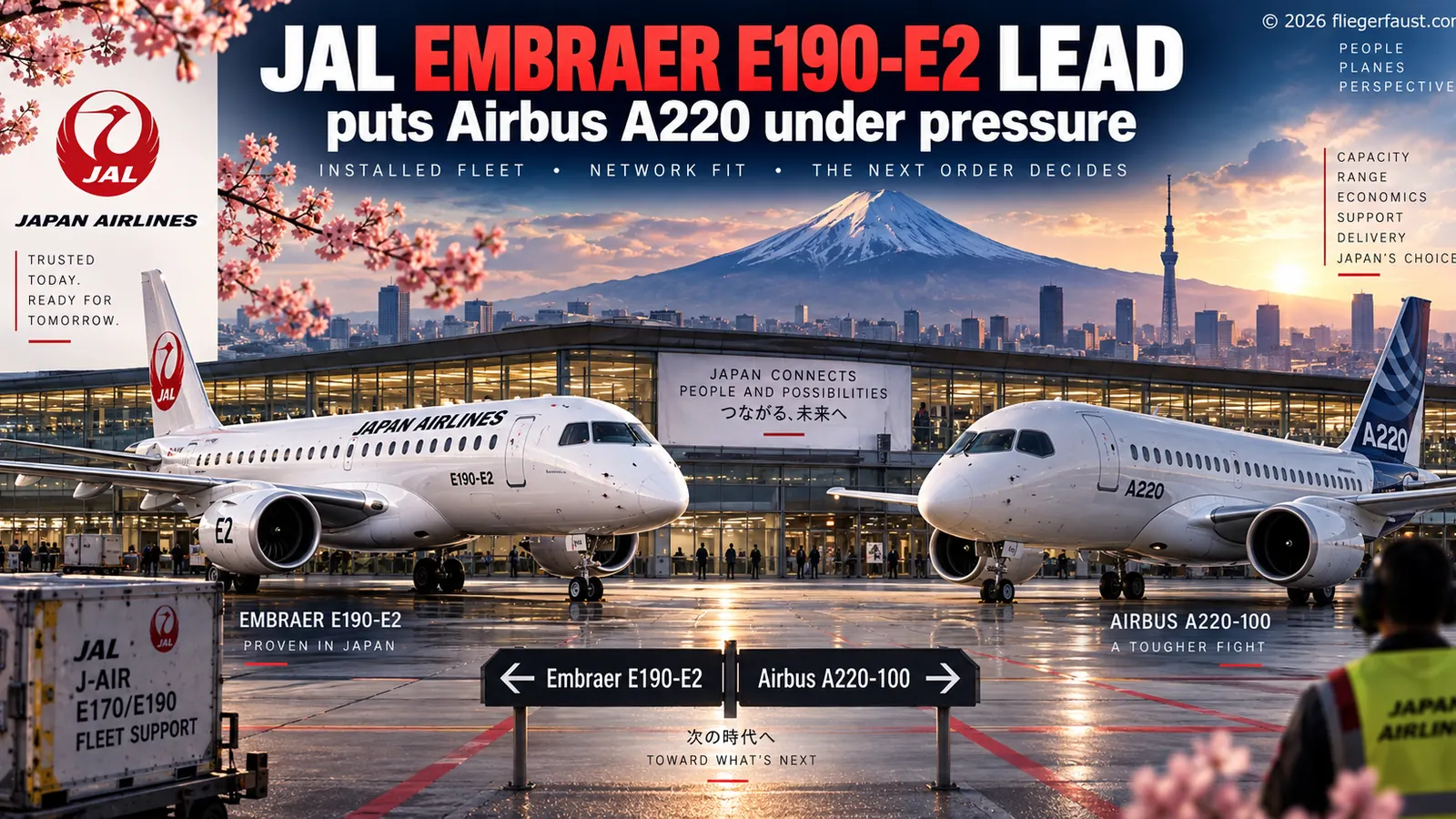
JAL E190-E2 momentum is building—but can Airbus still overturn Embraer’s installed-fleet advantage in Japan?
Japan Airlines (JAL) is leaning toward Embraer for an order of about 20 regional jets, according to The Japan Times, citing Bloomberg. The campaign pits the Embraer E190-E2 against the Airbus A220-100.
A final decision could come as early as October 2026.
Separately, ch-aviation summarized the same Bloomberg reporting. It noted that JAL had previously examined a broader renewal involving up to 40 regional jets and 30 turboprops.
Why Embraer starts with the installed-fleet advantage
Embraer enters the competition as JAL’s incumbent regional-aircraft supplier. Regional subsidiary J-Air operates 32 first-generation E170 and E190 aircraft across Japan.
That relationship gained fresh weight days before the order report appeared. Embraer announced a renewed multi-year Pool Program agreement covering JAL’s 32 E170 and E190 aircraft.
The programme provides access to repairable components and inventory positioned near the airline’s operation. Embraer also reported a 99.8% six-month service-reliability average for the fleet.
Airbus is therefore not entering a clean-sheet competition. It must displace an aircraft family, support structure and maintenance relationship already embedded in J-Air’s operation.
Capacity also strengthens Embraer’s case. The manufacturer lists 97 seats in a three-class configuration and 114 seats in a single-class layout at 29-inch pitch. Airbus lists the A220-100 at 100 to 120 passengers in typical service.
For thinner domestic routes, the smaller E190-E2 can preserve frequency without forcing JAL to fill additional seats. The A220-100 counters with a wider cabin and greater published range, but those advantages only matter when the network requires them.
JAL E190-E2: The Finnair warning for the A220 family
The Japanese campaign resembles the contest examined in our Fliegerfaust analysis of Finnair’s E195-E2 selection. Finnair chose the aircraft size and delivery profile that best matched its regional network, while the A220 offered more capacity and range.
Japan presents Airbus with an even harder commercial problem. J-Air already has years of E-Jet operating experience, and Embraer supports the fleet inside the country.
Rival ANA Holdings has also strengthened the Brazilian manufacturer’s position. On September 4, 2026, ANA ordered eight additional E190-E2s, increasing its firm total from 15 to 23 aircraft.
The Embraer filing with the United States Securities and Exchange Commission schedules ANA’s first E190-E2 delivery for 2028.
A JAL order would place both major Japanese airline groups behind the E190-E2 for regional-fleet renewal. It would also give Embraer greater local scale for training, spares, technical support and maintenance.
That matters beyond one campaign. Once an aircraft family develops a substantial in-country base, every later competition becomes harder for a rival to reopen.
Airbus’s wider A220 gains in Asia
Airbus still has significant A220 momentum across Asia. AirAsia’s firm order for 150 A220-300s became the programme’s largest single firm order.
Our Fliegerfaust report on the AirAsia A220 order examined what that commitment means for Mirabel production and the aircraft’s position in Asian markets.
Airbus is also expanding the programme’s regional support structure. A planned A220 simulator in Singapore should strengthen airline training capacity, as covered in our Fliegerfaust analysis of the A220 support network.
Those gains serve a different market requirement. AirAsia selected the larger A220-300 for thinner routes across an extensive low-cost network. JAL is comparing smaller aircraft for an established regional operation already built around Embraer equipment.
The distinction exposes the pressure on the A220-100. Airbus can win large strategic campaigns with the A220-300 while struggling in lower-capacity competitions against the E190-E2.
The A220-100’s cabin width, range and passenger appeal remain genuine strengths. They are not automatic answers for an airline prioritizing fleet continuity, support familiarity and disciplined seat capacity.
Conclusion: Airbus must answer the smaller-gauge problem
JAL has not signed the order, but current reporting places the E190-E2 ahead of the A220-100.
Embraer has converted incumbency, support performance and aircraft capacity into commercial leverage. ANA’s expanding order strengthens that position across the wider Japanese market.
A JAL selection would echo Finnair’s broader decision in favour of the E2 family, but the Japanese contest specifically compares the E190-E2 with the A220-100. A loss at JAL would raise serious questions about the smaller Airbus variant where airlines require fewer seats rather than additional range.
Airbus cannot answer every loss by pointing to the A220’s wider cabin or longer reach. It needs a sharper A220-100 proposition built around operating economics, delivery availability and local support.
If Airbus cannot displace an established E-Jet operator in one of Asia’s most important aviation markets, where can the A220-100 establish its next durable customer base?
Leave your comments below and on our Fliegerfaust Facebook page.
Sources
- The Japan Times — Embraer nears regional jet order from Japan Airlines in blow to Airbus (September 23, 2026).
- ch-aviation — JAL edges towards Embraer E2 order for 20 jets — report (September 23, 2026).
- Embraer — Japan Airlines renews Pool Program Agreement with Embraer to support E-Jet Operations (September 21, 2026).
- Embraer / U.S. Securities and Exchange Commission — ANA Holdings Inc. expands E190-E2 fleet with additional order for eight aircraft (September 4, 2026).
- Airbus — AirAsia places landmark order for 150 A220s (May 6, 2026).
- Airbus — A220 Family (accessed September 26, 2026).
- Embraer — E190-E2 (accessed September 26, 2026).
For full details, please refer to our Disclaimer page.