
Can a 54-seat airliner attract passengers who would otherwise choose a private jet?
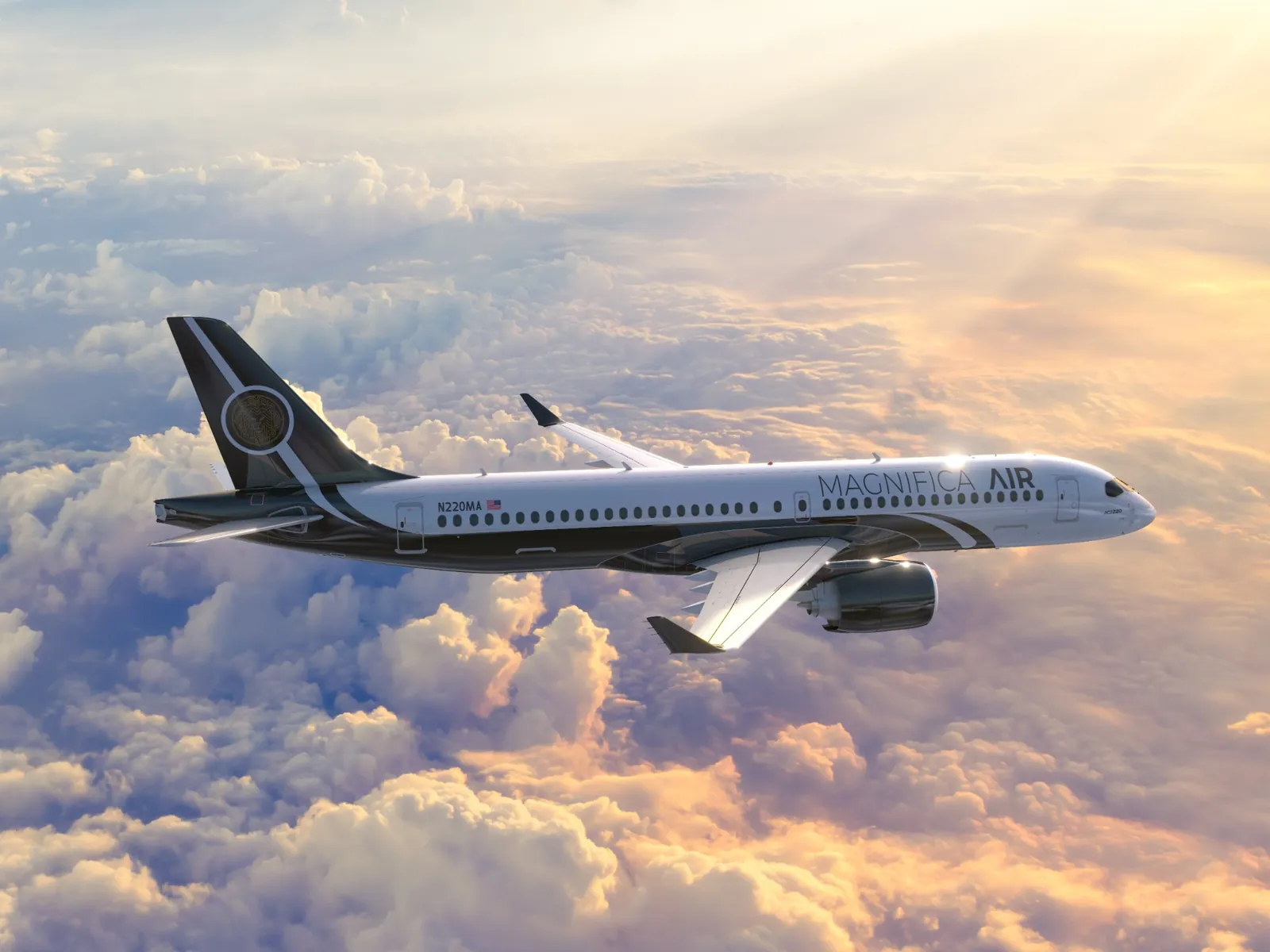
Magnifica Air A220: The Florida-based start-up has disclosed a firm order for ten ACJ220-300s. In a statement datelined November 10, 2026, Airbus Corporate Jets (ACJ) identified Magnifica as the previously undisclosed customer behind the order.
Magnifica is targeting a 2027 launch with private-terminal access and unusually spacious cabins. The larger A220-300 underpins this concept, alongside A321neos, rather than the smaller A220-100 used for the ACJ TwoTwenty.
Magnifica Air A220 order fits a 17-aircraft fleet plan
Airbus puts the planned fleet at 17 aircraft: 14 ACJ220s and three ACJ321neos. It has not published delivery dates or a contract value for the newly identified ten-aircraft order.
An earlier transaction provides part of that fleet’s foundation. On October 14, 2025, Air Lease announced leases covering four A220-300s and two A321-200neos, scheduled for delivery in 2027.
The four leased A220s plus the ten-aircraft order match the fourteen in Airbus’s latest fleet plan. The November disclosure identifies the customer behind an existing booking, rather than adding ten previously unrecorded aircraft to Airbus’s backlog.
For Magnifica, the distinction is between securing aircraft and assembling the service those aircraft will deliver. The lease commitments establish an initial delivery year; the new order extends the publicly identified aircraft pipeline.
“Our ACJ fleet is a critical part of delivering the Private Class experience.” — Wade Black, chief executive officer, Magnifica Air
That experience will require more than a generous seat map.
Magnifica Air A220 cabins trade seats for space
Corporate Jet Investor reported on November 10 that the ACJ220-300 configuration would accommodate 54 passengers in total in a cabin featuring one private suite. It also described cabins without overhead luggage bins.
The report compares that layout with approximately 150 seats in a typical airline A220. Using those figures, Magnifica would install roughly 64% fewer seats.
Magnifica’s October 15, 2025 launch announcement had proposed 45–54 passengers across its aircraft types. It described private suites, business-class recliners and a service positioned between commercial first class and private aviation.
The November report describes one suite, compared with two in Magnifica’s original A220-300 presentation. Airbus’s announcement specifies a customised, low-density cabin without publishing a final seat plan.
The Private Class airline has a different revenue equation
The commercial proposition depends on passengers paying for the space and service that replace conventional airline seating. Lower density creates room for privacy, but leaves fewer tickets across which to recover each flight’s costs.
Private-terminal access forms part of that proposition. Magnifica’s launch plan proposed arrival 30 minutes before departure, lounge-based screening, baggage assistance and ground transfers. Those are company service targets ahead of launch.
A customer choosing between this product and a whole-aircraft charter would still be choosing between different forms of flexibility. Magnifica proposes scheduled departures, selling a private-aviation-style experience within an airline operation.
The Magnifica Air A220 strategy therefore rests on a specific trade: scheduled departures and shared aircraft costs, with substantially fewer fellow passengers than a conventional airline cabin. Legroom is generous; revenue management has less room to manoeuvre.
Where the ACJ TwoTwenty connection matters
The Comlux ACJ TwoTwenty programme uses the A220-100 and accommodates up to 18 passengers. Magnifica’s order concerns the larger A220-300, with a cabin designed for a premium passenger service.
Range figures also belong to their respective configurations. Airbus quotes up to 4,000 nautical miles for the ACJ220-300 in an all-business layout. Airbus’s ACJ TwoTwenty specifications list 5,650 nautical miles and provision for up to five additional centre tanks. Airbus’s Magnifica announcement does not specify whether its ACJ220-300s will receive additional fuel capacity.
Those aircraft address different missions. One provides extensive living space for a small travelling party; the other uses a larger airframe to carry several dozen premium passengers.
The technical connection is stronger in cabin engineering and completion expertise. On April 6, 2026, Comlux announced Federal Aviation Administration approval for the TwoTwenty cabin through a supplemental type certificate.
As our Fliegerfaust coverage of the ACJ TwoTwenty cabin approval explains, that milestone supports the programme’s access to United States-registered aircraft.
The approval concerns the TwoTwenty cabin. Magnifica’s larger aircraft bring a separate configuration and completion programme, drawing on related A220 expertise. A family resemblance does not make the cabin drawings interchangeable.
Who completes the next Magnifica Air A220 cabins?
Comlux already has a documented role. The Comlux–Magnifica agreement announced in October 2025 covers six A220 cabin completions and two A321s, plus options.
That work encompasses structures, systems, interiors, connectivity and customised features. Comlux explicitly described the agreement as separate from its exclusivity covering the first seventeen ACJ TwoTwenty completions.
The earlier programme features (a must read) in our Fliegerfaust report on Magnifica’s Comlux partnership and A220 completion capacity. It establishes a supplier relationship, but the latest reporting differs over the newly ordered batch.
AeroTime’s November 11 report attributes the interior work to Comlux in Indianapolis. Corporate Jet Investor, however, reports that Magnifica is inviting proposals for its aircraft interiors. Airbus’s order announcement names no completion supplier.
The established Comlux contract is therefore clear; an award covering all ten newly disclosed aircraft remains unconfirmed in the manufacturer’s announcement.
The Magnifica Air A220 fleet needs a completion schedule
The earlier agreement says outfitting begins after aircraft deliveries, followed by certification and progressive deployment. For a customised fleet, those completion slots help determine when an aircraft can carry paying passengers.
That creates a second industrial schedule alongside airframe production. Seats, cabin systems, engineering and approvals have to arrive together. A particularly elaborate interior can become a critical part of the launch timetable.
The Magnifica Air A220 order consequently makes the completion decision commercially important. An airline selling cabin differentiation needs a supplier able to reproduce that product consistently across aircraft. Hand-crafted should describe the cabin, not the operating schedule.
Software and training support the Magnifica Air A220 fleet
Magnifica has also selected Skywise Core X1 for data analytics, together with flight-planning, operations, crew-management and navigation-database tools. Airbus describes the package as supporting both flight and technical operations.
For this business model, the useful connection is between the promised experience and the ability to deliver each departure. A personalised journey still depends on having an available aircraft, a qualified crew and a workable flight plan.
Software can support those decisions and bring operational information together. The test will be how Magnifica uses it when maintenance needs, crew availability or weather disrupt the planned service. Concierge service is easier when the aircraft is where the concierge expects it.
Training supports the Magnifica fleet plan
There is already a separate training commitment. On March 18, 2026, CPaT Global announced a contract for Magnifica’s pilot and cabin-crew training, covering A220 and A320-family courseware.
The package includes aircraft systems, pilot procedures and general subjects. Cabin-crew training covers systems, safety subjects and an interactive three-dimensional cabin trainer.
The contract supports the two aircraft families in Magnifica’s plans. It also places a concrete supplier agreement behind the broader promise of an airline-scale operation with a smaller, more individual passenger experience.
Preparing the airline for its proposed 2027 launch
Aircraft preparation was already under way before the November order disclosure. Aviation International News reported in October that Magnifica’s first A321neo was undergoing completion and its first A220-300 was in production.
The same reporting described recruitment across flight and ground operations, maintenance, guest services and corporate functions. Hiring was centred on Orlando, with the airline also building a network of prospective pilots, cabin crew and technicians.
Magnifica’s original network blueprint named Miami, New York, Los Angeles, the San Francisco Bay Area, Dallas and Houston. Seasonal services to Napa Valley and the Caribbean also featured in its 2025 launch release.
Those proposed markets provide a starting point for judging the concept. The important commercial question is whether enough passengers want this service on the same route, at useful departure times.
Private flying offers control over the journey. Magnifica is proposing to retain much of that experience while sharing the aircraft with other customers. Its challenge is to make the scheduled alternative sufficiently convenient to attract repeat business.
The Magnifica Air A220 investment puts aircraft behind that proposition. What remains to emerge is the operating timetable, the completion sequence and the service customers can actually book. A route map makes a useful introduction; the timetable does the harder work.
Conclusion: Taking Private Class from concept to service
Magnifica’s commitment gives the larger A220 a clearly identified role in a low-density premium fleet. The significance lies in the intended use: scheduled passenger services built around cabin space, private-terminal access and personalised treatment.
The next milestones should make the project easier to assess. Delivery allocations, completion awards, finished cabins and an operating schedule would connect the aircraft commitments with the proposed customer experience.
For the A220’s suppliers, this also broadens the work beyond conventional airline interiors. Cabin engineering, certification, crew preparation and operational systems become central to delivering the product Magnifica intends to sell.
The Magnifica Air A220 plan now has a firm aircraft commitment behind it. The commercial verdict will come from passengers who return, not the quality of the launch photographs.
Can Magnifica bring its first completed aircraft into service in 2027 and build repeat demand for its Private Class model?
Leave your comments below and on our Fliegerfaust Facebook page.
Sources
- Airbus Corporate Jets — Magnifica Air selects Airbus ACJ220-300s and Skywise digital solutions (November 10, 2026; release dateline).
- Air Lease — Air Lease Announces Lease Placement of Six New Airbus Aircraft with Magnifica Air (October 14, 2025).
- Corporate Jet Investor — Exclusive: Magnifica Air orders 10 ACJ220-300 aircraft from Airbus (November 10, 2026).
- Magnifica Air / PR Newswire — Magnifica Air Debuts at NBAA 2025 (October 15, 2025).
- Comlux — ACJ TwoTwenty programme by Comlux (undated; accessed November 12, 2026).
- Airbus Corporate Jets — ACJ TwoTwenty specifications (undated; accessed November 12, 2026).
- Comlux — Comlux America receives a Supplemental Type Certificate from the Federal Aviation Administration for Airbus ACJ TwoTwenty cabin (April 6, 2026).
- Comlux — Comlux America and Magnifica Air announce strategic alliance (October 14, 2025; release dateline).
- AeroTime — Magnifica Air confirms order for 10 A220 ACJ jets (November 11, 2026).
- CPaT Global — CPaT Announces New Contract with Start-Up Private Charter, Magnifica Air (March 18, 2026).
- Aviation International News — Magnifica Air Spooling up Operations with Hiring Drives (October 15, 2026).
For full details, please refer to our Disclaimer page.