

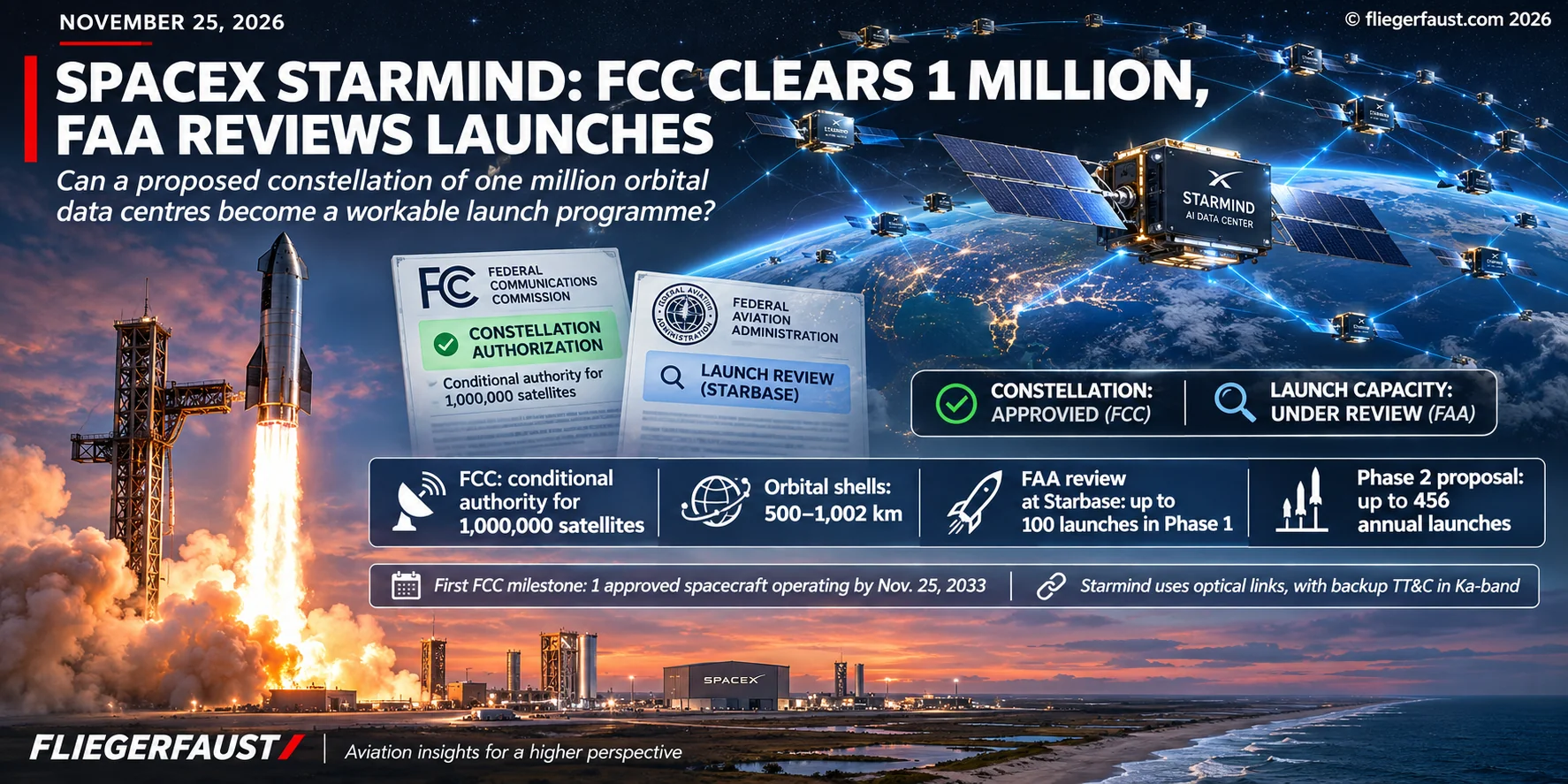
SpaceX Starmind: can a proposed constellation of one million orbital data centres become a workable launch programme? On November 25, 2026, the Federal Communications Commission (FCC) granted SpaceX conditional authority for its Starmind project, intended to process artificial intelligence (AI) workloads in low Earth orbit.
The decision concerns spacecraft and communications. A separate Federal Aviation Administration (FAA) process is examining much higher Starship launch activity in Texas. The two developments put regulatory permission and the capacity to use it into sharper focus.
SpaceX Starmind authorization comes with conditions
1 mllion satellites
The FCC’s November 25 order, numbered DA 26-1273, grants the application in part and defers other requests. SpaceX applied on January 30, 2026, seeking authority for up to one million satellites operating as orbital data centres.
The authorization specifies orbital shells between 500 and 1,002 kilometres, including inclined and Sun-synchronous orbits. The satellites would use optical communications, while the FCC permits limited backup and emergency radio links in specified Ka-band frequencies. Those links must operate without causing harmful interference.
The order sets unusually long deployment milestones. SpaceX must operate at least one approved spacecraft by November 25, 2033, reach 100,000 by November 25, 2035, and deploy half the permitted constellation by November 25, 2038. The remaining authorized spacecraft must be operating by November 25, 2040.
Those deadlines differ from SpaceX’s commercial ambitions. Spaceflight Now reported on November 26 that Elon Musk envisages initial Starmind launches in the third quarter of 2027. A company target is not the same as a regulatory deadline. The licence has a long calendar; making that calendar useful requires hardware.
SpaceX Starmind hardware is still a proposed design
SpaceX’s published AI1 Starmind design describes a satellite with a 75-metre deployed wingspan, a 30-metre height and a computing payload with a peak power requirement of up to 250 kilowatts. These are company design figures, not demonstrated performance from an operational constellation.
The proposed system relies on solar power, high-bandwidth optical links and connections through Starlink. SpaceX describes a manufacturing facility in Bastrop, Texas, intended to support large-scale production beginning as early as late 2027.
Processing data in orbit
Processing data in orbit also raises practical questions about power generation, heat rejection and maintenance. In a vacuum, waste heat must leave the spacecraft through radiation. Large radiators and dependable thermal controls matter as much as the processors themselves. A data centre can leave Earth; its heat still needs somewhere to go.
Manufacturing scale is another test. Our Fliegerfaust coverage of Boeing’s satellite production expansion examines the industrial challenge of building spacecraft at higher rates. Starmind would pursue a vastly larger volume, with final spacecraft mass and launch packaging still decisive unknowns.
SpaceX Starmind depends on Starship, but the FAA has a separate role
SpaceX identifies reusable Starship launches as essential to its proposed orbital-computing economics. The FCC authorization, however, is not a launch licence. The FAA separately reviews launch safety, operating permissions, airspace effects and environmental impacts.
On October 14, 2026, the FAA began scoping a programmatic environmental impact statement for expanded operations at Starbase. Its first proposed phase covers up to 100 Starship-Super Heavy launches annually. A second phase examines up to 456 launches and 912 combined stage landings per year.
Both figures are proposals under review, not flight rates the FAA has newly authorized. The 456-launch figure applies to the proposed Starbase operation, rather than a timetable assigned to Starmind alone. Public comments on the environmental-review scope remain open through December 7, 2026, under docket FAA-2026-12808.
No public launch manifest establishes how many Starmind satellites Starship could carry per mission. That requires the final spacecraft mass, deployment hardware and vehicle performance. An environmental review is not a launch-slot reservation.
SpaceX Starmind raises orbital safety and astronomy questions
The FCC also addressed collision risk and end-of-life disposal. It found the proposed mitigation measures for satellites operating below 600 kilometres consistent with its requirements. For spacecraft planned above 600 kilometres, SpaceX must submit a final mitigation plan and seek a licence modification before deployment.
The commission deferred a separate request to use alternative disposal methods, including disposal orbits or heliocentric trajectories. Approval of those methods would require further evidence and regulatory action. The FCC also requires six-monthly reports covering conjunction events, removals, reentries and the satellites actually deployed. Those disclosures could make the growing constellation’s operating record more measurable.
The American Astronomical Society condemned the authorization in its response: “disheartened and dismayed” — American Astronomical Society, November 25 statement. It raised concerns about reflected light, infrared emissions, radio astronomy, collision risk and atmospheric effects from launches and reentries. The FCC treated several non-spectrum concerns as outside the scope of this radio authorization.
SpaceX’s October 6 Starlink safety update counted more than 11,000 Starlink satellites in low Earth orbit. Starmind is a separate computing system, and its proposed ceiling is almost two orders of magnitude greater than that operating network. The number illustrates the difference between existing experience and the proposed industrial scale.
These questions go beyond one company. Our Fliegerfaust analysis of commercial megaconstellations and contested low Earth orbit examines the operational and security exposure created by proliferated spacecraft. Scale offers resilience, but also creates more interactions to monitor and manage.
Conclusion: Approval puts the next test on SpaceX
The SpaceX Starmind authorization establishes a legal pathway for an unprecedented proposed orbital-computing network. It also places measurable deployment obligations on the company, while preserving conditions on interference, debris mitigation and satellite disposal.
What follows depends on flight-tested hardware, repeatable production and Starship launches that can operate at sufficient scale. The FAA’s current review will shape launch possibilities at Starbase, but it does not guarantee the rates SpaceX seeks.
Will SpaceX demonstrate a working orbital data-centre cluster and the launch capacity needed to sustain it before the FCC’s first milestone comes due?
Leave your comments below this page and on our Fliegerfaust Facebook page.
Sources
- Federal Communications Commission — Starmind Memorandum Opinion and Order and Authorization, DA 26-1273 (November 25, 2026; accessible copy of the FCC order).
- Federal Communications Commission — FCC Authorizes 1 Million Satellites for Data Centers in Space (November 25, 2026).
- Spaceflight Now — FCC green lights SpaceX’s plan to launch 1 million Starmind data center satellites (November 26, 2026).
- SpaceX — Starmind AI1 satellite design and programme (undated; accessed November 26, 2026).
- Federal Aviation Administration — SpaceX Starship-Super Heavy project and environmental review (October 14, 2026 notice; accessed November 26, 2026).
- American Astronomical Society — AAS response to FCC approval of the SpaceX orbital data-centre system (November 25, 2026).
- SpaceX / Starlink — Space Safety: The Need for Improved Data Sharing Between Operators in Low-Earth Orbit (October 6, 2026).
For full details, please refer to our Disclaimer page.