

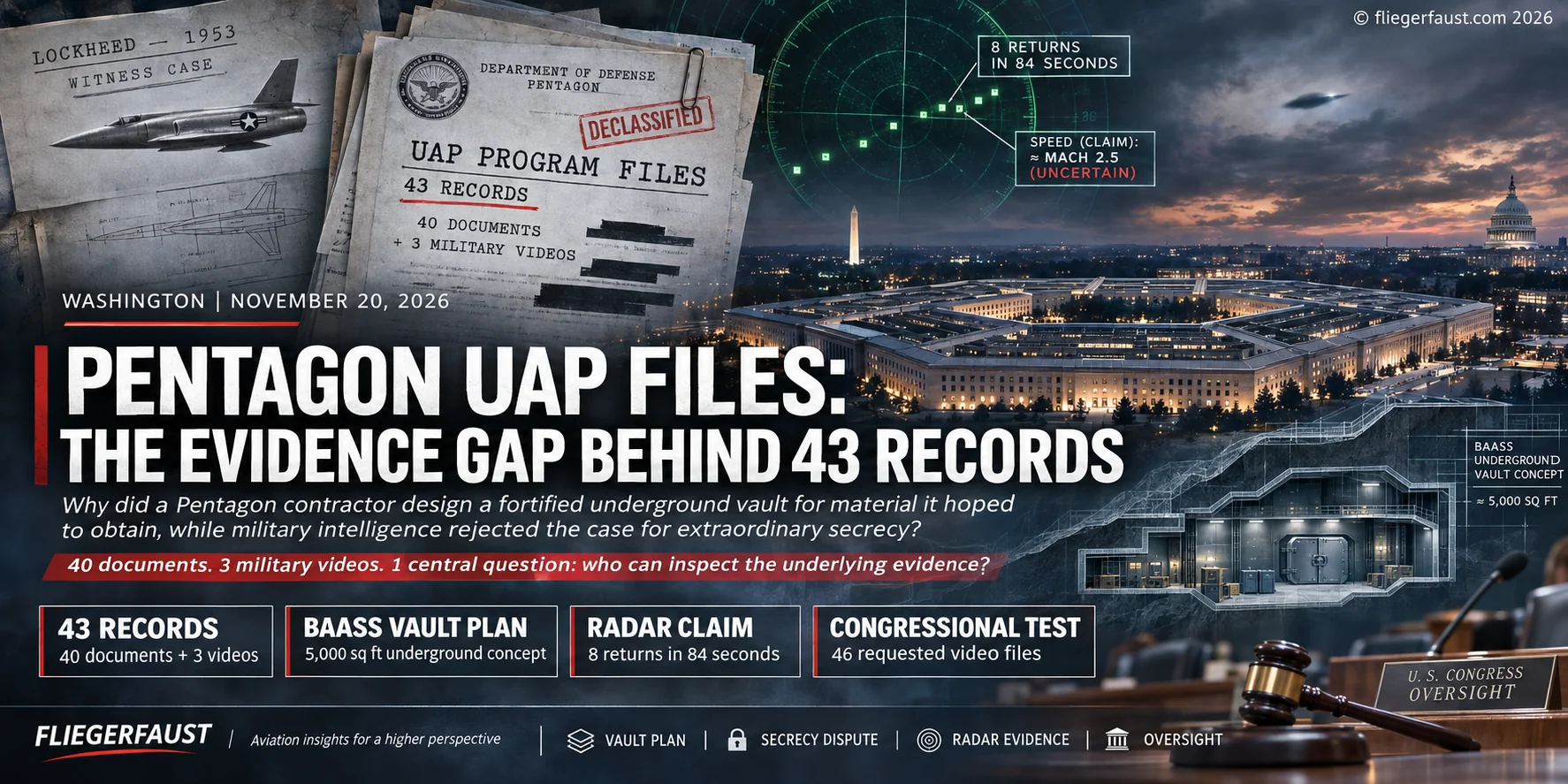
Why did a Pentagon contractor design a fortified underground vault for material it hoped to obtain, while military intelligence rejected the case for extraordinary secrecy?
Pentagon UAP files: Two records from 2009, newly presented together in Washington’s November 20, 2026 disclosure, deserve a much closer reading than another count of released files.
The eighth batch of the Presidential Unsealing and Reporting System for UAP Encounters (PURSUE) contains 40 documents and three military videos. Among them are contractor plans for collecting alleged recovered hardware, a Lockheed engineer’s firsthand account, and radar detections suggesting extraordinary speed—if a crucial assumption holds. A court ruled against David Grusch on the same day. Congress, meanwhile, has identified 46 requested video files without a public item-by-item accounting.
These Pentagon UAP files cannot be judged by their page count alone. The central issue is not whether the government has records. It plainly does. It is who can inspect the underlying evidence, challenge the conclusions and establish what happened to anything that was collected.
Pentagon UAP files reveal a plan for an underground vault
The most consequential new document may be DOW-UAP-D172, a 538-page report dated July 30, 2009. Bigelow Aerospace Advanced Space Studies (BAASS) prepared it for the Defense Intelligence Agency (DIA) under its Advanced Aerospace Weapon System Applications Program (AAWSAP) contract. The released report’s searchable transcription provides something more useful than retrospective testimony: a contemporaneous account of what the contractor wanted to build and why.
UAP evidence: a facility designed for possible recovered material
BAASS described plans for a 5,000-square-foot underground vault at Bigelow Aerospace’s North Las Vegas site. Its proposed walls, ceiling and floor were three feet thick, with a secure entrance and 15–20 feet of earth above. Surface structures were to be camouflaged. Construction and occupancy were projected for late 2009 or early 2010, subject to permits.
The stated purpose was to store any “exotic material or tissue” the company might acquire. Its report described a priority to pursue alleged recovered hardware and biological samples from businesses and private individuals, including possible contacts in Brazil.
Those are unusually specific plans. They establish that a defence-intelligence contractor was preparing to handle material it considered potentially remarkable. They do not establish that the vault was built, that material arrived, or that any sample was non-human. Those questions require building records, procurement files, accession logs, laboratory results and an identifiable chain of custody.
A contractor’s intentions are evidence of a programme’s ambitions. They are not yet an inventory of its holdings. But why was this sort of facility contemplated, and what became of the proposal?
The contractor’s own evidence was not uniformly extraordinary
The report is not a single uninterrupted claim of exotic technology. It describes 47 full-time employees, nine research projects and a database holding 237,331 records. It also recounts military encounters and field investigations whose evidentiary quality varies sharply.
In one interview concerning a 2007 encounter near RAF Lakenheath, the F-15 flight lead later considered whether the object might have been a balloon. The same BAASS document preserves that possibility. An investigation serious about the vault should be equally serious about such counter-evidence.
The harder question concerns custody, not labels. Did BAASS receive objects, specimens or source data from any of these inquiries? If so, who examined them, and where are the resulting records? Publishing an acquisition strategy without its outcome leaves the decisive half of the story outside public inspection.
Pentagon UAP files expose a dispute inside defence intelligence
These Pentagon UAP files become more revealing beside Senator Harry Reid‘s June 24, 2009 request for restricted special-access protection. Reid argued that the programme involved sensitive, unconventional aerospace findings. He wanted access limited beyond ordinary classified handling.
DIA did not simply agree. A November 13, 2009 DIA memorandum, preserved through Freedom of Information Act (FOIA) disclosures, said it could not find adequate justification for a restricted Special Access Program. The reviewers said the first-year deliverables were unclassified and that the contractor had not established a secure facility for classified work.
UAP secrecy: who decided what deserved protection?
The memorandum also records DIA’s view that no report delivered to that point contained information sensitive enough to justify the extra restrictions Reid sought. Its authors anticipated some future work might involve classified foreign technical information, but that was not a basis to compartment the entire programme.
That is a remarkable contrast. A contractor was designing a heavily protected storage site; a senator was seeking exceptional security; and the intelligence agency’s reviewers were unconvinced by the deliverables before them.
There is no necessary contradiction in the narrow legal sense. A physical vault for potential samples is not the same thing as an accredited facility for classified documents, and the memorandum addressed the latter security regime. Conflating them would manufacture a finding the records do not support.
Yet the documentary disagreement raises legitimate questions. Which deliverables did DIA inspect? What evidence supported Reid’s description? Did later work change the security assessment? And if no sensitive material justified special access in November 2009, what explains subsequent claims about hidden programme holdings?
These are questions for the agencies and contractors involved, not a reason to presume either that Reid had been vindicated or that the programme was empty. For the Pentagon UAP files, an official refusal is a recorded decision. It is not an exhaustive examination of every lead the contractor pursued.
Pentagon UAP files: A Lockheed case tests the Air Force
Another of the Pentagon UAP files, DOW-UAP-D206, reaches back to December 16, 1953. It contains statements by Lockheed chief engineer Clarence “Kelly” Johnson and personnel aboard a Lockheed flight-test aircraft near Point Mugu, California. The 15-page scanned record is far more substantial than a secondhand saucer anecdote.
Johnson described a dark, sharply outlined ellipse above the western horizon near his Agoura ranch. It appeared stationary for several minutes before moving away and vanishing. He considered smoke and a lenticular cloud, then questioned those explanations because its outline remained fixed and its apparent departure differed from the surrounding clouds.
Several witnesses, one official label
A Lockheed test crew in a Navy WV-2 Super Constellation independently reported a dark, wing-like shape in approximately the same direction and time window. Johnson’s account and the crew statements are mutually relevant, though they do not establish that every observer saw precisely the same physical object.
The Air Force case card categorizes the event as “Lenticular Cloud”. The scan preserves that conclusion but does not supply a detailed weather reconstruction explaining the reported departure. The card is on a form bearing a September 1963 revision date, which also leaves the timing of that particular classification entry unclear.
Could it have been a cloud? Certainly. A stationary lens-shaped silhouette against a sunset is compatible with one. But compatibility is not the same as demonstrating an identification. These Pentagon UAP files supply no photographic triangulation, radar record or reliable distance to determine size or speed. Johnson himself said he could not estimate the object’s dimensions.
The witness testimony deserves scrutiny, including Johnson’s prior belief that saucers might exist. So does the Air Force’s classification. Why accept a short official label as more complete than several signed technical accounts when the supporting analysis is absent from the published file?
Our earlier Fliegerfaust examination of the 1966 FBI UFO material addressed the same distinction: an authentic government document can preserve a claim without proving it. Here the reverse deserves attention too. A government classification can preserve an explanation without showing how investigators established it.
Pentagon UAP files contain a speed claim built on uncertainty
A modern example in the Pentagon UAP files makes that problem measurable. The one-page radar record DOW-UAP-D165 concerns eight returns over 84 seconds from a civil air-surveillance radar in the western United States in 2023. Their estimated altitude was 55,000–70,000 feet.
The sum of successive straight-line separations is approximately 38.5 miles. Dividing that distance by 84 seconds produces about 1,650 miles per hour, or roughly Mach 2.5 at the reported altitude. The slide also shows an apparent 39-degree change in bearing after roughly 48 seconds.
UAP radar: the red line is not a flight path
Here the fine print is decisive. The slide explicitly says the 12-second radar sweep interval cannot establish that all eight detections came from one object. Its red connecting line represents sequential point-to-point displacement, not a reconstructed trajectory.
That makes the arithmetic correct under its stated assumption and the physical conclusion unproven. Multiple objects, track-association mistakes or imperfect radar returns remain possible. So does a genuinely unusual contact. The public data do not distinguish them.
AARO should release enough sanitized information for an independent radar specialist to reproduce the association: detection timestamps, positional uncertainty, altitude method, sensor coverage, filtering criteria and the reasoning used to connect returns. It should also explain why the slide uses language suggesting a single “track” while simultaneously warning that continuity is unverified.
An extraordinary speed claim should not depend on readers overlooking an asterisk. Nor should an agency’s caution be allowed to substitute indefinitely for a documented technical investigation.
UAP metadata: even the catalogue needs an audit
The metadata provide another warning. The same release describes a 2023 radar incident, but some archive indexes display July 15, 2005 in its date field. Separately, the official DVIDS entry for a 2023 CENTCOM video lists November 18, 2026 as its “Date Taken”.
These could be data-conversion or processing errors. They do not establish manipulation of the underlying events. But publication without a clear distinction among incident, acquisition, processing and release dates weakens the public evidence trail.
Who can inspect the original collection metadata? Which fields have been altered during declassification? A file catalogue is not the sensor recording; it should not be permitted to obscure its history.
Pentagon UAP files face a court and congressional test
On November 20, Judge Leonie M. Brinkema entered judgment for the Defense Department in David Grusch’s FOIA case, 1:26-cv-00607. The public docket records summary judgment for the government and denial of Grusch’s competing motion.
The dispute concerned the handling of a records request, not a judicial examination of alleged recovered craft or non-human technology. The docket does not make the ruling a verdict on those allegations. Nor does losing a FOIA case answer every question about what records different offices hold, how they searched or what they are permitted to disclose.
UAP oversight: 46 requests require identifiable answers
Congress has a more concrete starting point. Its March 31, 2026 letter to the Pentagon specified 46 video files, with delivery requested by April 14. The list includes an alleged formation over Iran, an incident associated with Lake Huron, and numerous military-platform recordings identified by call signs and dates.
The November release adds three CENTCOM clips. That is not an item-by-item answer to the House’s earlier list. The public still needs to know which requested files were delivered privately to Congress, which are publicly available, which were withheld, and which descriptions might refer to duplicate clips. Those are different questions, and a release counter cannot answer them.
Our earlier Fliegerfaust report on Congress’s 46-video demand documented the original deadline. Our subsequent investigation of the disclosure standoff asked whether the agencies holding the records could also dictate the public’s definition of transparency. The November release offers a chance to test that proposition with a proper reconciliation table.
A whistleblower inside the oversight effort
On November 18, Representative Eric Burlison appointed Jake Barber as a senior UAP adviser. Barber has publicly claimed experience with recovery operations. His appointment confirms a congressional role; it does not independently corroborate those claims.
Barber has said the aim is to follow testimony with technical measurements, multiple observations and reliable documents. That standard should apply without exception, including to his own accounts. Congress can investigate witnesses and compel records, but it must not replace one closed circle of institutional assurance with another circle of trusted insiders.
The proposed independent review board in UAP legislation might change how evidence is preserved and examined. Yet the measure’s passage through the House is not enactment. Until meaningful access exists, oversight remains dependent on what record holders provide.
Conclusion: The next release must answer harder questions
The Pentagon UAP files establish a documented contractor plan for potential material storage, an intelligence-agency dispute about secrecy, firsthand aerospace witness testimony and instrumented detections requiring further analysis. None, individually or together, proves an extraordinary origin. Nor do they justify accepting an unsupported official conclusion merely because it appears in an official file.
The first test is specific. Account for the BAASS vault and any material accession records. Publish the analytic basis for the Lockheed cloud classification, if it survives. Make the radar associations independently testable. Reconcile the congressional video requests against the inventory actually delivered, without confusing private access and public disclosure.
A government can be right about a case and still fail to show its work. It can also be wrong. The evidence—not the authority of the person presenting it—must decide.
Will Congress demand the underlying custody records and sensor data, or will the next Pentagon release simply add another row to a growing list of unanswered questions?
Leave your comments below and on our Fliegerfaust Facebook page.
Sources
- Department of War — PURSUE UAP records archive (Release 08, November 20, 2026).
- UAP Trail — PURSUE Release 08 inventory and document identification (November 20, 2026).
- BAASS / UAPTEE — DOW-UAP-D172, Ten Month Report, July 30, 2009, searchable transcription (released November 20, 2026; transcription of government-published file).
- Defense Intelligence Agency / The Black Vault — Review of Special Access Program Request, U-09-2660 (November 13, 2009).
- Lockheed Aircraft Corporation / WatchTheStars archive — DOW-UAP-D206, California 1953, complete 15-page scan (released November 20, 2026).
- AARO / UAP Reading Room — DOW-UAP-D165, radar detections in the western United States (released November 20, 2026).
- Defense Visual Information Distribution Service — DOW-UAP-PR169, Middle East, 2023: video entry and metadata (posted November 20, 2026).
- U.S. House Committee on Oversight and Government Reform — Letter requesting UAP videos from the Pentagon (March 31, 2026).
- U.S. District Court / CourtListener — Grusch v. United States Department of Defense, case 1:26-cv-00607 (judgment November 20, 2026).
- Representative Eric Burlison — Burlison Names UAP Whistleblower Jake Barber Senior Adviser (November 18, 2026).
For full details, please refer to our Disclaimer page.