
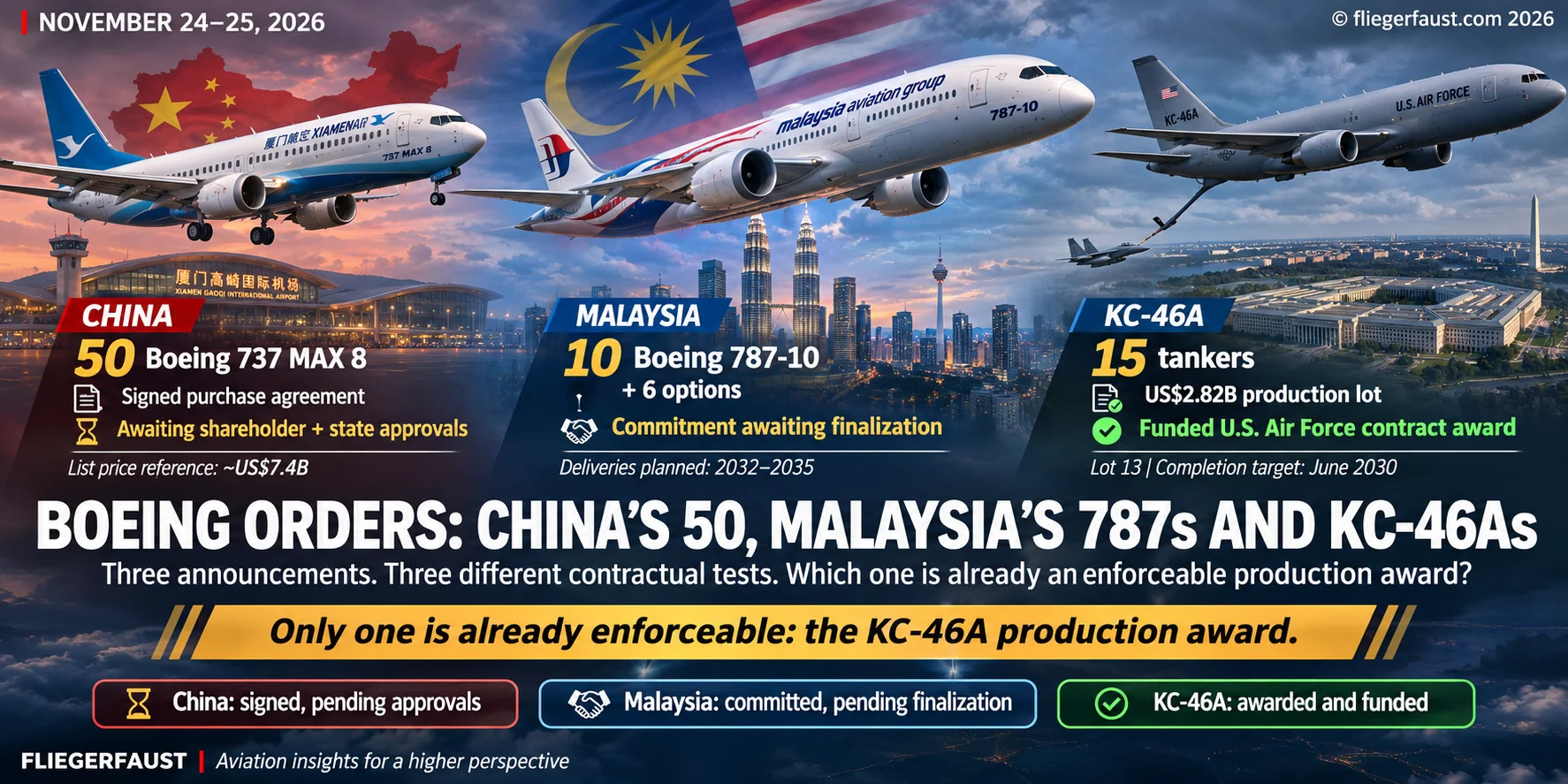
Boeing orders: which of three November announcements is already an enforceable production award?
China’s Xiamen Airlines signed for 50 single-aisle jets, Malaysia Aviation Group selected the 787-10, and the United States Air Force contracted 15 tankers. The numbers sound straightforward. Their contractual status is not.
Across November 24–25, Boeing gained a Chinese purchase agreement awaiting approvals, a Malaysian commitment awaiting finalization, and a funded military production lot. Treating all three as interchangeable firm orders would obscure the most important differences.
Boeing orders in China: 50 jets await approval
China Southern Airlines disclosed on November 24 that its 55%-owned subsidiary Xiamen Airlines had signed an agreement for 50 Boeing 737 MAX 8 aircraft. The Hong Kong stock-exchange filing schedules deliveries from 2031 to 2034 and gives the jets a combined catalogue price of approximately US$7.4 billion.
That is not the agreed transaction value. China Southern states that Boeing granted price concessions, while contractual confidentiality prevents disclosure of the actual price. Calling US$7.4 billion booked revenue would turn a list-price reference into an invented invoice.
A signed purchase is not yet an effective purchase
China Southern’s board approved the agreement. However, shareholder approval and authorization from the relevant Chinese authorities remain necessary before the purchase takes effect. Reuters reported that this is Boeing’s largest Chinese aircraft agreement in nearly a decade.
The airline ties the acquisition to its planned move to Xiamen Xiang’an International Airport and expansion of its Fujian hub network. China Southern also identifies an earlier purchase of 137 Airbus A320neo-family aircraft as complementary. The manufacturer split is a fleet decision, not proof of a wholesale Chinese return to Boeing.
Our Fliegerfaust investigation of the proposed 500-jet China deal followed the negotiations surrounding the Trump–Xi summit. The Xiamen filing now names an airline, aircraft variant and delivery window. It does not establish whether these 50 jets belong to any larger government-level commitment. A diplomatic headline can be expansive; a purchase agreement has to specify the aircraft.
Xiamen’s chosen Boeing 737 MAX 8 also brings the familiar production question. The type relies on CFM International’s LEAP-1B engines, whose industrial supply requirements we examined in our Fliegerfaust analysis of LEAP engine investment. Delivery slots for the early 2030s still depend on a functioning production system.
Boeing orders in Malaysia: 10 787-10s and 6 options
On November 25, Boeing announced that Malaysia Aviation Group (MAG) intends to acquire 10 Boeing 787-10 Dreamliners, with an opportunity to take 6 additional aircraft. Boeing explicitly describes the transaction as one to be finalized. The 6 are options, not firm sales.
MAG’s own announcement calls the plan an acquisition and places deliveries between 2032 and 2035. The different wording should not conceal Boeing’s qualification: the purchase is not yet a finalized order in the manufacturer’s announcement.
The bigger story is the Airbus A350 replacement
MAG plans to phase out its existing 7 Airbus A350 aircraft during that delivery period. It proposes a 319-seat, three-class cabin for the Boeing 787-10 and identifies London, Paris, Sydney, Melbourne, Tokyo, Osaka and Seoul among potential markets. Actual route assignments remain subject to network and operational planning.
The variant matters. Boeing lists a maximum range of up to 7,500 nautical miles for the 787-10, but a published range is not a guaranteed payload on every route. Replacing A350 capacity on long sectors will require careful choices about aircraft allocation, cabin weight and operating conditions. The fleet decision is more interesting than the ceremonial signing.
GE Aerospace confirmed the selection of GEnx-1B engines for the planned aircraft. MAG also renewed GE flight-efficiency software agreements. Engine support and in-service economics will matter long after the announcement photographs disappear.
The first Dreamliners are not due until 2032. Our Fliegerfaust reporting on the Airbus–Boeing delivery crunch provides context for the gap between selling future capacity and reliably handing over finished widebodies.
Boeing orders for KC-46A: a funded US$2.82 billion lot
The military announcement has a different contractual standing. On November 24, the US Air Force awarded Boeing a US$2,819,046,560 contract modification covering 15 KC-46A Pegasus tankers in production Lot 13. Air & Space Forces Magazine reported that completion is scheduled for June 30, 2030.
Unlike the Chinese agreement awaiting approvals or the Malaysian commitment awaiting finalization, this is an awarded and funded procurement action. The amount also covers related data, subscriptions and licences. Dividing it by 15 does not produce a clean airframe-only sales price.
The 203-aircraft figure is not a delivery count
Boeing’s November 24 statement says 203 KC-46As are on contract or in service worldwide. It separately reports 116 delivered to the US Air Force, 6 to Japan and two to Israel. That is 124 delivered aircraft under the reported counts, not 203 aircraft already flying.
Lot 13 completes the Air Force’s original 184-aircraft procurement programme. The Air Force plans to procure another 75 KC-46As through a separate production extension, but has not finalized that agreement with Boeing. Officials have linked finalization to correcting outstanding tanker deficiencies.
The new lot also costs more. Air & Space Forces Magazine calculated a 14.2% increase over the previous 15-aircraft lot, whose contract value was approximately US$2.47 billion. The tanker programme continues to address problems with its remote vision system, including a planned upgraded system expected to begin entering service in late 2027 or early 2028.
A new production award demonstrates continued military demand. It does not, by itself, certify that every technical problem has disappeared. The refuelling boom has little interest in a sales headline.
Conclusion: Three announcements, three different tests
These Boeing orders should not be added into an invented tally of firm aircraft. Xiamen has signed for 50 jets but still needs regulatory and shareholder approvals. Malaysia has selected 10 787-10s plus 6 options, while Boeing awaits finalization. The Air Force has awarded a funded contract for 15 KC-46As.
The next useful evidence will be Chinese approvals, final Malaysian purchase documents and KC-46A production against the 2030 deadline. Boeing has customers across commercial and defence markets. The harder question is how reliably those commitments become deliverable aircraft.
Which of these November agreements will produce the first measurable improvement in Boeing’s delivered-aircraft record?
Leave your comments below and on our Fliegerfaust Facebook page.
Sources
- China Southern Airlines / Hong Kong Exchanges and Clearing — Major Transaction in Relation to Purchase of Aircraft (November 24, 2026).
- Reuters — China Southern orders 50 jets in Boeing’s biggest China deal in nearly a decade (November 24, 2026).
- Boeing — Malaysia Aviation Group Commits to Order up to 16 Boeing 787 Dreamliner Jets (November 25, 2026).
- Malaysia Aviation Group — Malaysia Aviation Group Acquires 10 Boeing 787 Dreamliner Aircraft to Strengthen Long-Haul Fleet (November 25, 2026).
- Boeing — 787 Dreamliner (accessed November 26, 2026).
- GE Aerospace — Malaysia Aviation Group Selects GE Aerospace GEnx Engines to Power New 787 Dreamliners (November 25, 2026).
- Air & Space Forces Magazine — Air Force Gives Boeing $2.8B Contract for More KC-46s, as Price Rises (November 25, 2026).
- Boeing — Boeing to Build 15 Additional U.S. Air Force KC-46A Tankers (November 24, 2026).
For full details, please refer to our Disclaimer page.