

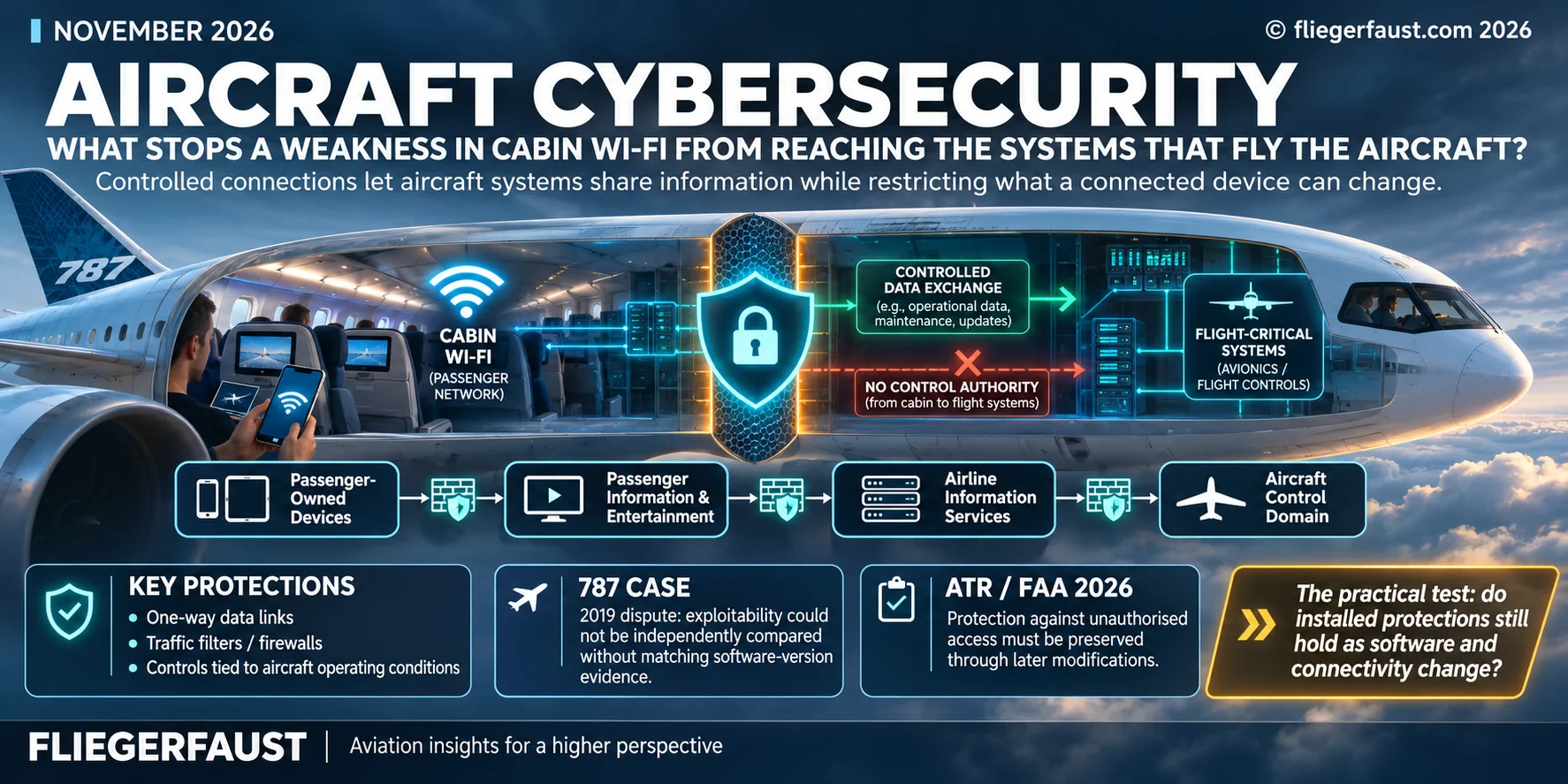
Aircraft cybersecurity: what stops a weakness in cabin Wi-Fi from reaching the systems that fly the aircraft?
Controlled connections let aircraft systems share information while restricting what a connected device can change. Examples include one-way data links, traffic filters and controls tied to aircraft operating conditions.
In 2019, a Boeing 787 investigation left unresolved whether the researcher and manufacturer assessed matching software versions. The practical test is whether an installed aircraft’s protections hold as airlines update its software and connectivity.
An August 7, 2026 decision for Avions de Transport Régional (ATR) illustrates the continuing obligation. For a proposed ATR 42-500 and ATR 72-212A upgrade, the United States Federal Aviation Administration (FAA) required protection against unauthorised access. ATR must also provide procedures preserving that protection through later modifications.
Aircraft cybersecurity starts with four different domains
A passenger’s phone, an airline’s entertainment server and a flight-control computer have different jobs and different security requirements. A European Union Aviation Safety Agency (EASA)-commissioned study describes four functional domains that separate those responsibilities.
The map groups functions; manufacturers decide how to implement them in computers, networks and protected interfaces. Your phone earns the imposing title Passenger-Owned Devices Domain. It remains the same phone.
| Functional domain | What belongs there | What crosses its boundary |
|---|---|---|
| Aircraft Control Domain | Flight controls, navigation and other essential aircraft functions | Selected flight information can leave through controlled interfaces. Protection must preserve the systems that produce it and control the aircraft. |
| Airline Information Services Domain | Airline-managed applications for flight crews, cabin crews and maintenance | Operational information and authorised maintenance exchanges, with access appropriate to each job. |
| Passenger Information and Entertainment Services Domain | Installed entertainment, passenger information and internet services | Passenger requests and selected aircraft information, handled by equipment the airline manages. |
| Passenger-Owned Devices Domain | Travellers’ phones, tablets and laptops | Connections to passenger services from devices whose software the airline does not control. |
How network separation permits useful connections
An aircraft can send its remaining flight time to cabin systems without giving those systems control over the flight. A Hamburg University of Technology paper describes that one-way exchange and another permitted message: a passenger calling a cabin attendant. Each connection has a specific destination and purpose.
The paper applies industry domain guidance in an experimental cabin platform. Its four-domain model describes responsibilities, rather than prescribing four physical networks for every aircraft.
The United States Government Accountability Office (GAO) describes several concrete protections. A one-way data connection limits the direction of transfer. A firewall filters traffic against rules about permitted communications. Other controls restrict software loading to an aircraft’s ground operating state.
Together, these controls limit message type, direction and timing. Aircraft cybersecurity depends on the installed combination. A drawing with separate boxes tells only part of that story.
Aircraft cybersecurity inside the 787 dispute
The FAA confronted passenger access when it certified the Boeing 787-8. During consultation, the Air Line Pilots Association (ALPA) wanted a backup means for pilots to disconnect passengers from sensitive networks.
The FAA’s 2008 special conditions allowed automatic isolation, crew intervention or both. The regulator required protection but left Boeing flexibility over the mechanism. That distinction matters: compliance establishes an obligation and an accepted design, while a vulnerability dispute asks whether particular protections withstand a particular attack.
IOActive’s Ruben Santamarta obtained firmware for Honeywell’s crew and maintenance server from a publicly accessible Boeing server. Firmware is embedded software controlling equipment. His analysis focused on three interconnected networks.
| Boeing 787 network | Function |
|---|---|
| Open Data Network (ODN) | Passenger entertainment and external communications; less-trusted equipment. |
| Isolated Data Network (IDN) | Connects restricted equipment, including the Crew Information System/Maintenance System File Server Module Santamarta studied. |
| Common Data Network (CDN) | High-integrity aircraft backbone connecting avionics and other systems. |
Santamarta found memory-handling flaws in the IDN server. He proposed reaching it from the ODN, then progressing towards the CDN. His offline analysis lacked installed systems or an aircraft to test the effects.
The avionics security test that outsiders cannot compare
Boeing told WIRED it tested an actual 787 in flight mode and could not reproduce the attack. It cited protections in the server against access from the ODN. It also described separate hardware between the IDN and CDN, allowing data transfers while excluding executable commands. Honeywell disputed any flight-safety threat; the FAA accepted Boeing’s assessment.
IOActive said Boeing and Honeywell acknowledged flaws but disputed exploitability. Boeing, it said, withheld its tested firmware version and methodology. IOActive could not validate the mitigations. A version number is a modest request in an industry that counts rivets.
For aircraft cybersecurity, the important question is whether a flaw can survive those successive checks and affect a safety-critical function. The published accounts lack the software and test details needed to compare the competing answers.
What the incidents and research establish
On August 10, 2026, the crew of Delta Air Lines Flight 591 switched off cabin Wi-Fi for about 30 minutes. An unauthorised wireless network had appeared aboard the Boeing 757 flying from Las Vegas to Atlanta.
In its statement to FOX5 Las Vegas, Delta said the other network was not its own. The carrier reported no affected aircraft operating systems and no breach of its Wi-Fi. It did not identify who operated the unauthorised network.
Australia produced a more concrete criminal case. An airline crew’s report of suspicious Wi-Fi in April 2024 led investigators to equipment holding stolen credentials and fraudulent sign-in records. The Australian Federal Police account, carried by The National Tribune, describes activity at airports and on domestic flights.
Australian Broadcasting Corporation court reporting identified Michael Clapsis and the impersonated Qantas service. In November 2025, a Perth court sentenced him to seven years and four months for multiple offences. Those included separate offending involving intimate material. The familiar airline name on a login page had proved a poor identity check.
Cabin Wi-Fi research reaches beyond the login page
Billing systems present another target. In Cloud Nine Connectivity, researchers reported weaknesses involving two major in-flight Wi-Fi providers. Penn State’s publication record identifies the 2025 study and its findings: unpaid access and use of another subscriber’s bandwidth. Only the abstract was available for this investigation.
The aircraft cybersecurity record also reaches installed communications equipment. In IOActive’s 2018 satellite-communications investigation, Santamarta reported exposed airborne terminals and weaknesses affecting non-safety communications. The potential consequences included interception or disruption of communications and attacks on connected devices.
The study’s aviation assessment recorded a security risk, with no flight-safety risk for the scenario examined. Its disclosure account said affected airlines subsequently stopped exposing their fleets to the internet. That finding concerned aircraft equipment, and the remedial action concerned how outsiders could reach it.
Aircraft intrusion claims and gaps in the public record
Other disclosures carried more dramatic implications. In November 2017, Department of Homeland Security (DHS) official Robert Hickey described remote radio access to a Boeing 757 during a 2016 test.
The department told Business Insurance the environment was artificial, details remained classified and risk-reduction measures were already in place. Boeing disputed that the exercise identified a cyber vulnerability in its aircraft. The public account leaves the system reached, the access obtained and the observed aircraft consequence undisclosed.
A Federal Bureau of Investigation affidavit filed in April 2015 records researcher Chris Roberts’s claim of reaching a thrust-management computer through entertainment equipment. He told investigators he caused an aircraft to move sideways during an earlier flight.
The affidavit separately records signs of tampering on seat electronics inspected in Philadelphia on April 15, 2015. That physical finding establishes neither who caused the damage nor the claimed change in aircraft movement. Boeing’s written response said the alleged intrusion was incompatible with its aircraft architecture and layered protections.
Roberts named a thrust-management computer, but the affidavit supplies no technical record corroborating that access or the claimed aircraft movement. Hickey’s public account leaves the system and access level unidentified. Those distinct gaps limit independent assessment of these aircraft cybersecurity claims.
Aircraft cybersecurity needs checks after delivery
The argument over independent testing has already reached the regulator. In its 2020 report, GAO urged the FAA to consider procedures for safely testing protections on the deployed fleet.
The FAA objected that testing could corrupt aircraft systems and jeopardise safety. GAO replied that testing standards provide precautions, including an isolated test environment. It argued for recurring checks as threats evolve. Both positions address a real operational problem: testing must expose weaknesses without leaving an aircraft unsafe to operate.
The GAO recommendation tracker records what followed. In November 2023, the FAA said it had reviewed its procedures and considered existing controls sufficient. GAO closed that recommendation because the FAA had performed the requested review. In an October 2024 update on a separate recommendation, the FAA reported issuing guidance that included security test plans for aircraft designs.
GAO closed the recommendation while the FAA maintained its objection to independent testing of aircraft in service. The label implemented can fit a surprisingly unfinished argument. What matters for aircraft cybersecurity is whether safeguards remain effective as equipment and threats change.
In-flight connectivity changes during an aircraft’s life
Operators have defined responsibilities. The FAA’s 2023 guidance on aircraft network-security programmes addresses aircraft operating under network-security special conditions. It covers controlled loading equipment, signed software, configuration checks, replacement parts, maintenance and security logs.
These measures connect the approved design to the aircraft actually flying. A replacement computer must run an appropriate software configuration. Maintenance personnel need controlled tools and procedures. Security logs can reveal events requiring investigation. The circular also protects sensitive documentation; its absence from public view tells readers little about an operator’s records.
Such changes are already part of fleet development. Fliegerfaust’s Air France A220 coverage describes Starlink connectivity retrofits alongside continuing deliveries. In business aviation, Fliegerfaust’s Bombardier reporting follows Gogo Galileo retrofit certification for Challenger aircraft.
Those examples involve different aircraft and approvals. Both show why an aircraft cybersecurity assessment has a service life: airlines and owners keep changing the connectivity product. The relevant question is whether each approved change preserves the protections around the systems it touches.
What the FAA proposal and European rules require
The FAA proposed common cybersecurity criteria in August 2024. They would replace repeated special conditions with standard requirements covering relevant aircraft, engine and propeller designs.
The Office of Information and Regulatory Affairs timetable listed July 2026 for a final rule. Searches of the official record through November 28, 2026 found the proposal but no final-rule publication. Meanwhile, the ATR decision imposed its own requirements for the specified design change.
Europe already separates design protection from organisational risk management. EASA’s Certification Specification 25.1319 addresses intentional, unauthorised electronic interactions that could affect aircraft safety. It calls for risk assessment, mitigation and instructions to maintain protection where needed.
EASA’s information-security framework, Part-IS, adds duties for covered aviation organisations and authorities. Delegated Regulation 2022/1645 applies from October 16, 2025; Implementing Regulation 2023/203 from February 22, 2026. The duties include identifying safety-related risks, detecting incidents, responding and recovering. An approved design and an organisation’s continuing ability to manage threats answer different parts of aircraft cybersecurity.
Flight-deck exposure also arrives through the radio
A September 2026 GAO investigation documents interference and weaknesses in aircraft communications beyond passenger networks. It describes messaging systems that lack authentication or encryption and depend partly on procedural checks. Crews may need to confirm suspect messages by voice. Navigation interference can also deprive them of reliable position information.
These hazards can affect crews through a route independent of the cabin network. A forged radio message and an intrusion through passenger equipment require different protections, even when both concern the flight deck. Identifying the entry point determines which safeguards investigators need to examine.
Aircraft cybersecurity gains a new wireless question
A wireless sensor can now help a technician check a business jet’s tyres. Parker Meggitt’s iPRESS technical leaflet describes wheel-mounted sensors sending pressure readings to a smartphone app using Bluetooth Low Energy.
Its May 2024 table lists FAA and EASA supplemental type certification for the Cessna Citation Mustang and CJ4, among other models. Parker also requires a quarterly cross-check using a manufacturer-approved method. Wireless, it turns out, still comes with paperwork.
That is an approved maintenance application with a defined procedure. The more ambitious development is Wireless Avionics Intra-Communications (WAIC): links between installed equipment on the same aircraft, supporting safe operation.
The International Telecommunication Union’s 2015 WAIC resolution sets conditions for operation in the 4.2–4.4 gigahertz band. Radio altimeters also use that band. They measure height above the surface, making coexistence particularly consequential near landing.
Wireless avionics must deliver a trustworthy reading on time
The Aerospace Vehicle Systems Institute identifies possible applications including smoke detection, landing-gear position and brake-temperature sensing. Replacing wiring can reduce installation constraints, but each proposed use brings its own operational demands.
A technician consulting a pressure reading can pause and cross-check it. An aircraft system using a sensor during flight must handle missing, late or misleading information within the time that function allows. Aircraft cybersecurity therefore concerns the source and integrity of the reading as well as interference that prevents its arrival.
International Civil Aviation Organization radio provisions, applicable from November 27, 2025, address WAIC coexistence with radio altimeters, including nearby aircraft. Clear reception alone, however, does not establish that a message came from the intended sensor.
The European Organisation for Civil Aviation Equipment’s ED-319 announcement describes radio specifications and a reference security architecture. Published in July 2025, the standard supplies a framework for designers; its full paid text was unavailable for this review.
The programme and standards records examined through November 28, 2026 identified no verified airline-service installation of WAIC in that band. A named approval, installation and operator would establish that next step. The tyre-pressure reader has documented approval for a narrower maintenance application, with specified continuing checks.
Conclusion: The protection must survive the next change
The public record supports a clear finding: aircraft security depends on several barriers working together. A weakness in one component makes the remaining protections crucial. The four-domain map explains the design intent; an installed-system test can show how a particular configuration responds to a challenge.
Public investigations have exposed weaknesses in passenger services and aircraft communications equipment. The 787 case goes further into a maintenance component, where Boeing and IOActive disagreed about the consequences. Their accounts leave outsiders unable to compare software versions, methods and results on a common basis. That is the central unresolved evidentiary issue.
The ATR conditions make continued protection an explicit responsibility as operators modify the design. Existing maintenance programmes provide mechanisms for doing so. Connectivity retrofits and prospective wireless sensors increase the importance of testing whether those mechanisms still work after a change.
For aircraft cybersecurity, the next useful advance would be a version-matched, safely conducted assessment with results that an independent reviewer can examine. It should identify the protections tested, the relevant operating conditions and what happened when those protections faced a challenge. Sensitive implementation details can require protection; the industry can still explain who checked the result and what the assessment established.
When the next connected system enters service, what independent evidence will show that the flight-critical boundary still holds?
Leave your comments below and on our Fliegerfaust Facebook page.
Sources
- Federal Aviation Administration — Special Conditions: ATR-GIE Avions de Transport Régional Model ATR42-500 and ATR72-212A Airplanes; Electronic System Security Protection From Unauthorized Internal Access (August 7, 2026).
- EUROCAE Communication for the European Union Aviation Safety Agency — Analysis of the evolution of air/ground communication (August 3, 2016).
- Hamburg University of Technology, German Aerospace Congress — An ARINC 664 P5- and ARINC 853-compliant Platform Enabling Suppliers to Develop Digital Aircraft Cabin Solutions (2026).
- United States Government Accountability Office — Aviation Cybersecurity: FAA Should Fully Implement Key Practices to Strengthen Its Oversight of Avionics Risks (October 9, 2020).
- Federal Aviation Administration — Special Conditions: Boeing Model 787-8 Airplane; Systems and Data Networks Security—Isolation or Protection From Unauthorized Passenger Domain Systems Access (January 2, 2008).
- IOActive — Arm IDA and Cross Check: Reversing the 787’s Core Network (August 7, 2019).
- WIRED — A Boeing Code Leak Exposes Security Flaws Deep in a 787’s Guts (August 7, 2019).
- FOX5 Las Vegas — Delta flight from Las Vegas deactivates onboard WiFi after unauthorized network detected (August 11, 2026).
- Australian Federal Police, via The National Tribune — WA man jailed for stealing intimate material and using ‘evil twin’ WiFi networks (November 28, 2025).
- ABC News — Perth hacker Michael Clapsis jailed after setting up fake Qantas Wi-Fi, stealing sex videos (November 28, 2025).
- Penn State Research Portal — Cloud Nine Connectivity: Security Analysis of In-Flight Wi-Fi Paywall Systems (June 30, 2025).
- IOActive — Last Call for SATCOM Security (August 2018).
- Business Insurance — Aircraft cyber risks seen as low but potentially catastrophic (January 2018, page 7).
- Federal Bureau of Investigation, via DocumentCloud — Affidavit in United States District Court case 5:15-mj-00154-ATB (descriptive label; filed April 17, 2015).
- Boeing Commercial Airplanes — Boeing Response Statement for News Media Queries — Claims of hacking IFE systems (undated; accessed November 28, 2026).
- United States Government Accountability Office — Avionics cybersecurity report and recommendation status (descriptive label; accessed November 28, 2026).
- Federal Aviation Administration — Operational Authorization of Aircraft Network Security Program, AC 119-1A (September 28, 2023).
- Federal Aviation Administration — Equipment, Systems, and Network Information Security Protection (proposed rule; August 21, 2024).
- Office of Information and Regulatory Affairs — Equipment, Systems, and Network Information Security Protection (Unified Agenda entry; accessed November 28, 2026).
- European Union Aviation Safety Agency — CS-25 Amendment 25 — Change Information (accessed November 28, 2026).
- European Union Aviation Safety Agency — Part-IS regulation published, completing regulatory framework for cyber-resilient aviation (February 2, 2023).
- United States Government Accountability Office — Aviation Cybersecurity: Enhanced Air Safety Requires FAA to Better Mitigate Threats to Aircraft Communications (September 21, 2026).
- Parker Meggitt — Wireless Tire Pressure Gauge (certification table dated May 2024).
- International Telecommunication Union — Resolution 424: Use of Wireless Avionics Intra-Communications in the frequency band 4 200–4 400 MHz (World Radiocommunication Conference 2015).
- Aerospace Vehicle Systems Institute — About WAIC (undated; accessed November 28, 2026).
- International Civil Aviation Organization, via the Swiss Federal Office of Civil Aviation — Annex 10, Volume V — Aeronautical Radio Frequency Spectrum Utilization (Amendment 91 applicable November 27, 2025).
- European Organisation for Civil Aviation Equipment — New Publication: ED-319 “MOPS for a Wireless Avionics Intra-Communication System” (July 30, 2025).
For full details, please refer to our Disclaimer page.